11.2 Goodness-of-Fit Test

🎲Intro to Statistics Unit 11 Review
11.2 Goodness-of-Fit Test
🎲 Intro to Statistics
The goodness-of-fit test checks whether sample data matches a specific probability distribution. You collect observed frequencies from your data, calculate what the frequencies should be under the hypothesized distribution, and then use a chi-square statistic to measure the gap between the two. A large gap means the data probably doesn't follow the distribution you proposed.
Goodness-of-Fit Test

Top images from around the web for Goodness-of-fit test for distributions
Goodness-of-Fit Test | Introduction to Statistics View original
Is this image relevant?
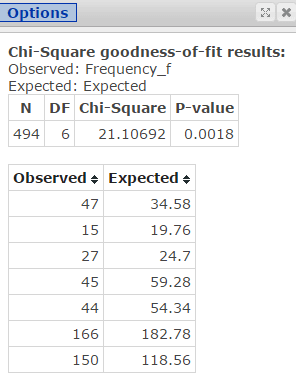
Chi-square Goodness of Fit test View original
Is this image relevant?
PSPP for Beginners View original
Is this image relevant?
Goodness-of-Fit Test | Introduction to Statistics View original
Is this image relevant?
Chi-square Goodness of Fit test View original
Is this image relevant?
Goodness-of-fit test for distributions
This test answers a straightforward question: does your sample data come from a population with a particular probability distribution (normal, binomial, Poisson, uniform, etc.)?
- Null hypothesis (): The data follows the specified distribution.
- Alternative hypothesis (): The data does not follow the specified distribution.
Steps to perform the test:
- State your null and alternative hypotheses.
- Calculate the expected frequency for each category based on the hypothesized distribution.
- Calculate the chi-square test statistic using observed and expected frequencies.
- Determine degrees of freedom and find the critical value from the chi-square distribution table.
- Compare the test statistic to the critical value and decide whether to reject or fail to reject .
- Optionally, calculate the p-value to assess how strong the evidence is against .

Test statistic calculation
The chi-square test statistic measures how far your observed data deviates from what you'd expect under :
- = observed frequency for category
- = expected frequency for category
- = number of categories
How to find expected frequencies: Multiply the total sample size by the probability of each category under the hypothesized distribution. For example, if you have 200 observations and the hypothesized distribution says category A should contain 30% of values, then .
Each expected frequency should be at least 5 for the chi-square approximation to be reliable. If any expected count falls below 5, you may need to combine adjacent categories.
Degrees of freedom:
- = number of categories
- = number of parameters you estimated from the sample data
If the hypothesized distribution is fully specified in advance (e.g., "each category has equal probability"), then and . But if you estimated a parameter from the data first (like using the sample mean as the Poisson rate), you lose an additional degree of freedom for each estimated parameter.

Interpretation of chi-square results
The goodness-of-fit test is always a right-tailed test. That's because the chi-square statistic can only be zero or positive: small values mean the data fits well, and large values mean it doesn't.
- Find the critical value from the chi-square distribution table using your degrees of freedom and significance level (typically ).
- If : Reject . There is sufficient evidence that the data does not follow the specified distribution.
- If : Fail to reject . There is not enough evidence to conclude the data differs from the specified distribution.
You can also use the p-value approach: if the p-value is less than , reject . The p-value tells you the probability of getting a test statistic at least as extreme as yours, assuming is true.
Additional Considerations
- The goodness-of-fit test is a nonparametric test, meaning it doesn't require assumptions about the shape of the population distribution. It works directly with frequency counts.
- It's designed for categorical data. If you have continuous data, you'll need to group it into categories (bins) first.
- The same chi-square framework extends to other tests you'll encounter, like the test of independence and the test of homogeneity, which use contingency tables instead of a single row of categories.
See Fiveable more often in Google
Mark Fiveable as a preferred source and Google is more likely to show you our guides in Top Stories, with a "preferred" badge in AI Mode and AI Overviews.