3.1 Federal Question Jurisdiction

🪜Civil Procedure Unit 3 Review
3.1 Federal Question Jurisdiction
🪜 Civil Procedure
Federal Question Jurisdiction
Federal question jurisdiction gives federal courts the power to hear cases that involve federal law. This matters because without it, federal statutes and constitutional provisions could be interpreted differently by courts in every state. The doctrine rests on both a constitutional foundation (Article III) and a statutory grant (28 U.S.C. § 1331), and understanding the gap between those two is one of the trickiest parts of this topic.

Top images from around the web for Constitutional Basis and Purpose
Federalism: Basic Structure of Government | United States Government View original
Is this image relevant?
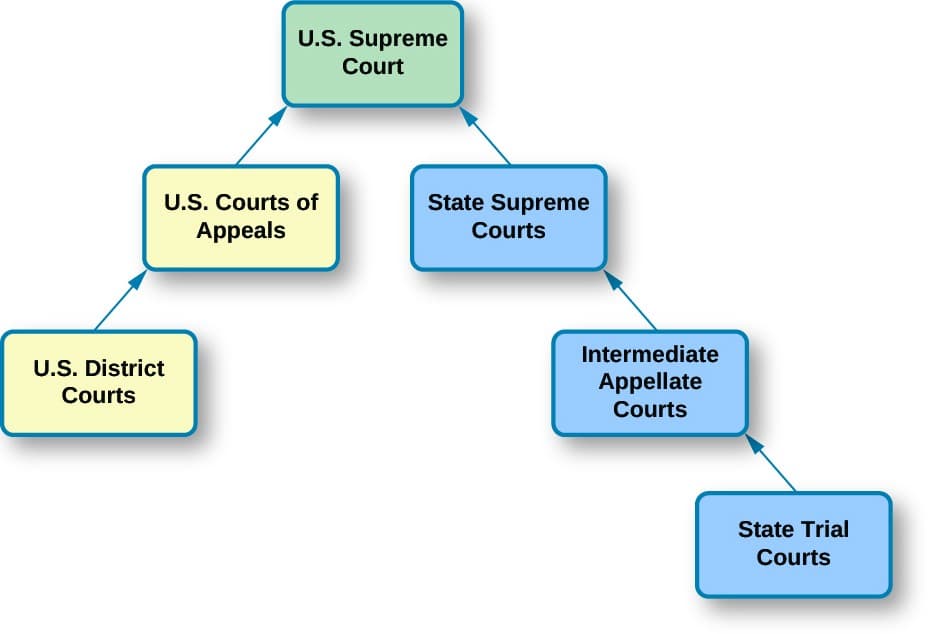
The Dual Court System | American Government View original
Is this image relevant?
U S Courts: Structure and Procedure | United States Government View original
Is this image relevant?
Federalism: Basic Structure of Government | United States Government View original
Is this image relevant?
The Dual Court System | American Government View original
Is this image relevant?
Constitutional Basis and Purpose
Article III, Section 2 of the U.S. Constitution extends federal judicial power to all cases "arising under" the Constitution, federal laws, and treaties. This is the broadest possible scope of federal question jurisdiction.
A few things to keep straight here:
- The constitutional "arising under" power is wider than what Congress has actually granted to federal courts by statute. Congress can narrow the jurisdiction federal courts exercise, but it can't expand it beyond Article III's limits.
- The purpose is uniformity: federal law should mean the same thing whether you're in California or Maine.
- Federal question jurisdiction is entirely separate from diversity jurisdiction, which is based on the citizenship of the parties. Different basis, different rules.
Think of it this way: Article III sets the ceiling. Congress decides where to place the floor.
Statutory Requirements for Federal Question Jurisdiction
28 U.S.C. § 1331
The key statute is straightforward on its face: federal district courts have original jurisdiction over "all civil actions arising under the Constitution, laws, or treaties of the United States."
Two things to note about § 1331:
- There is no amount-in-controversy requirement. Congress eliminated the previous minimum in 1980. (Diversity jurisdiction under § 1332 still has one, so don't mix them up.)
- The statute uses the same "arising under" language as Article III, but courts have interpreted it more narrowly than the constitutional provision.

The Well-Pleaded Complaint Rule
This is the gatekeeper for statutory federal question jurisdiction. The federal issue must appear on the face of the plaintiff's properly pleaded complaint. That means:
- Look only at what the plaintiff needs to prove to win, as stated in the complaint.
- Ignore anticipated defenses. Even if the defendant will definitely raise a federal defense, that doesn't create federal question jurisdiction.
- Ignore counterclaims. A federal counterclaim doesn't give the court jurisdiction over the original case.
The classic example: a plaintiff sues for breach of contract under state law, and the defendant plans to argue the contract is preempted by federal law. That federal preemption defense does not make this a federal question case under the well-pleaded complaint rule.
Supplemental Jurisdiction (28 U.S.C. § 1367)
Once a case properly lands in federal court on a federal question, § 1367 lets the court also hear related state law claims that form part of the same case or controversy. This promotes judicial economy by keeping related issues in one forum.
Courts can decline supplemental jurisdiction in certain situations, such as when the state law claim raises novel or complex issues of state law, or when the state claims substantially predominate over the federal claims.
The "Arising Under" Test
This is where the analysis gets more nuanced. There are two main paths into federal question jurisdiction:

Path 1: Federal Law Creates the Cause of Action
If a federal statute creates the plaintiff's cause of action, the case automatically "arises under" federal law. No further analysis needed.
- A suit under 42 U.S.C. § 1983 (civil rights violations by state actors) is a federal question case.
- A patent infringement suit under federal patent law is a federal question case.
- A claim under federal securities law is a federal question case.
Path 2: State Law Claim with an Embedded Federal Issue (the Grable Test)
This is the harder scenario. Sometimes a plaintiff brings a state law claim, but resolving it requires answering a significant federal question. The Supreme Court addressed this in Grable & Sons Metal Products, Inc. v. Darue Engineering & Manufacturing (2005).
Under Grable, a state law claim can "arise under" federal law for § 1331 purposes if the federal issue is:
- Necessarily raised by the plaintiff's claim
- Actually disputed between the parties
- Substantial to the federal system as a whole
- Capable of resolution in federal court without disrupting the federal-state balance of judicial responsibilities
All four elements must be met. This is a demanding test, and most state law claims with some federal flavor won't satisfy it.
Grable vs. Merrell Dow: Understanding the Line
These two cases illustrate where the line falls:
Grable (jurisdiction found): A state quiet title action required determining whether the IRS had given proper notice under federal tax law before seizing property. The federal tax notice question was disputed, substantial to the federal government's interest in tax enforcement, and wouldn't open the floodgates to a huge volume of new federal cases.
Merrell Dow (jurisdiction denied): A state law negligence claim alleged that a drug company violated federal labeling requirements. The Court found that Congress had not created a private right of action for the federal labeling violation, and treating every state tort claim referencing a federal regulatory standard as a federal case would overwhelm federal courts.
The key distinction: Grable involved a discrete federal issue important to the federal system that wouldn't generate a flood of cases. Merrell Dow would have turned a massive category of state tort litigation into federal cases.
Federal Causes of Action vs. State-Law Claims with Federal Issues
| Feature | Federal Cause of Action | State Claim with Embedded Federal Issue |
|---|---|---|
| Jurisdiction analysis | Automatic | Requires Grable four-part test |
| Created by | Federal statute, Constitution, or federal common law | State law, but resolution depends on a federal question |
| Examples | § 1983 claims, antitrust, securities fraud, patent infringement | State property dispute turning on federal tax law; state contract case requiring interpretation of federal telecommunications law |
| Complexity | Straightforward | Requires balancing federal interest against risk of overburdening federal courts |
For exam purposes, the first thing to check is whether the plaintiff's claim is created by federal law. If yes, you're done. If the claim is created by state law, move to the Grable analysis and work through all four factors carefully.
See Fiveable more often in Google
Mark Fiveable as a preferred source and Google is more likely to show you our guides in Top Stories, with a "preferred" badge in AI Mode and AI Overviews.