5.3 Enzyme inhibition and activation

🔬Biological Chemistry I Unit 5 Review
5.3 Enzyme inhibition and activation
🔬 Biological Chemistry I
Enzyme inhibition and activation are crucial for regulating metabolic processes. Different types of inhibition, like competitive and non-competitive, affect enzyme kinetics in unique ways. Understanding these mechanisms helps explain how drugs work and how cells control their metabolism.
Enzyme regulation involves activators and allosteric effectors that fine-tune enzyme activity. Feedback inhibition, where end products inhibit earlier enzymes in a pathway, maintains metabolic balance. These processes are vital for cellular homeostasis and adapting to changing conditions.
Types of Enzyme Inhibition
Competitive Inhibition
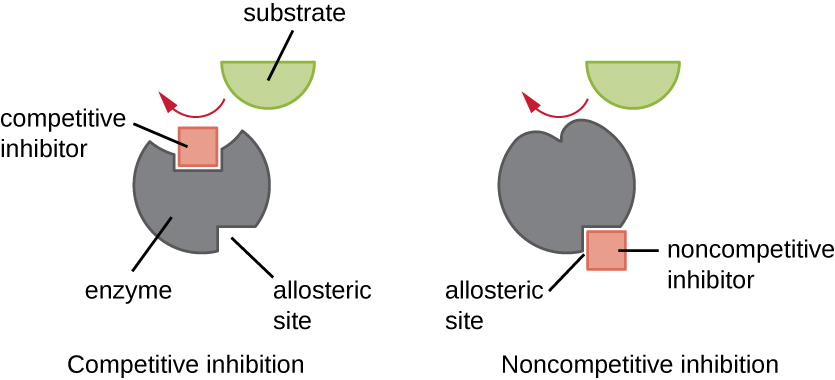
- Occurs when an inhibitor molecule binds to the active site of an enzyme, preventing substrate binding
- Inhibitor competes with the substrate for the active site
- Increasing substrate concentration can overcome competitive inhibition
- Inhibitor and substrate have similar structures (aspirin and acetylsalicylic acid)
- Competitive inhibitors increase the Km value without affecting the Vmax
- Lineweaver-Burk plot shows increased slope and x-intercept, but unchanged y-intercept
Non-Competitive and Uncompetitive Inhibition
- Non-competitive inhibition involves an inhibitor binding to an allosteric site, distinct from the active site
- Non-competitive inhibitors do not affect substrate binding but reduce the enzyme's catalytic efficiency
- Non-competitive inhibition decreases Vmax without changing Km (heavy metal ions like lead and mercury)
- Uncompetitive inhibition occurs when an inhibitor binds only to the enzyme-substrate complex
- Uncompetitive inhibitors decrease both Vmax and Km (some antibiotics like ampicillin)
- Lineweaver-Burk plot for non-competitive inhibition shows increased slope and y-intercept, but unchanged x-intercept
- Uncompetitive inhibition Lineweaver-Burk plot shows decreased slope, x-intercept, and y-intercept

Reversible and Irreversible Inhibition
- Reversible inhibition involves non-covalent interactions between the inhibitor and enzyme
- Reversible inhibitors can dissociate from the enzyme, allowing the enzyme to regain activity (most competitive, non-competitive, and uncompetitive inhibitors)
- Irreversible inhibition involves covalent bonding between the inhibitor and enzyme
- Irreversible inhibitors permanently inactivate the enzyme by altering its structure
- Irreversible inhibition cannot be overcome by increasing substrate concentration (pesticides and nerve agents like sarin gas)
Enzyme Regulation
Enzyme Activators and Allosteric Effectors
- Enzyme activators are molecules that increase the activity of enzymes
- Activators can bind to allosteric sites, causing conformational changes that enhance enzyme activity
- Allosteric effectors are molecules that bind to allosteric sites and modulate enzyme activity
- Positive allosteric effectors increase enzyme activity (calcium ions activating calmodulin)
- Negative allosteric effectors decrease enzyme activity (ATP inhibiting phosphofructokinase)
- Allosteric regulation allows for fine-tuning of enzymatic activity in response to cellular conditions
Feedback Inhibition and Metabolic Regulation
- Feedback inhibition is a regulatory mechanism where the end product of a metabolic pathway inhibits the activity of an earlier enzyme in the pathway
- Feedback inhibition helps maintain homeostasis by preventing the excessive accumulation of end products
- End products often act as allosteric inhibitors, binding to enzymes and reducing their activity
- Feedback inhibition allows for efficient resource allocation and prevents wasteful production of unnecessary metabolites (isoleucine inhibiting threonine deaminase in the biosynthesis pathway)
- Metabolic regulation through feedback inhibition is crucial for maintaining balanced cellular metabolism and responding to changing cellular needs (ATP and NADH levels regulating glycolysis and the citric acid cycle)
See Fiveable more often in Google
Mark Fiveable as a preferred source and Google is more likely to show you our guides in Top Stories, with a "preferred" badge in AI Mode and AI Overviews.