5.3 Enzyme inhibition and activation
Updated August 2024Fiveable Content Team

🔬Biological Chemistry I Unit 5 Review
5.3 Enzyme inhibition and activation
🔬 Biological Chemistry I
Unit 5 – Enzymes – Kinetics and Regulation
Enzyme inhibition and activation are crucial for regulating metabolic processes. Different types of inhibition, like competitive and non-competitive, affect enzyme kinetics in unique ways. Understanding these mechanisms helps explain how drugs work and how cells control their metabolism.
Enzyme regulation involves activators and allosteric effectors that fine-tune enzyme activity. Feedback inhibition, where end products inhibit earlier enzymes in a pathway, maintains metabolic balance. These processes are vital for cellular homeostasis and adapting to changing conditions.
Types of Enzyme Inhibition
Competitive Inhibition
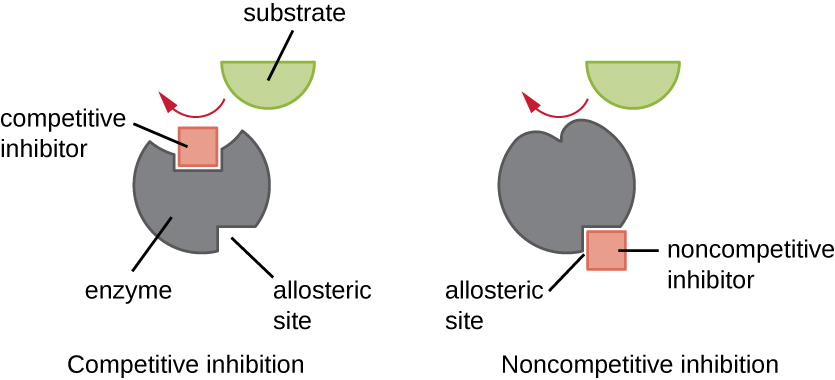
- Occurs when an inhibitor molecule binds to the active site of an enzyme, preventing substrate binding
- Inhibitor competes with the substrate for the active site
- Increasing substrate concentration can overcome competitive inhibition
- Inhibitor and substrate have similar structures (aspirin and acetylsalicylic acid)
- Competitive inhibitors increase the Km value without affecting the Vmax
- Lineweaver-Burk plot shows increased slope and x-intercept, but unchanged y-intercept
Non-Competitive and Uncompetitive Inhibition
- Non-competitive inhibition involves an inhibitor binding to an allosteric site, distinct from the active site
- Non-competitive inhibitors do not affect substrate binding but reduce the enzyme's catalytic efficiency
- Non-competitive inhibition decreases Vmax without changing Km (heavy metal ions like lead and mercury)
- Uncompetitive inhibition occurs when an inhibitor binds only to the enzyme-substrate complex
- Uncompetitive inhibitors decrease both Vmax and Km (some antibiotics like ampicillin)
- Lineweaver-Burk plot for non-competitive inhibition shows increased slope and y-intercept, but unchanged x-intercept
- Uncompetitive inhibition Lineweaver-Burk plot shows decreased slope, x-intercept, and y-intercept

Reversible and Irreversible Inhibition
- Reversible inhibition involves non-covalent interactions between the inhibitor and enzyme
- Reversible inhibitors can dissociate from the enzyme, allowing the enzyme to regain activity (most competitive, non-competitive, and uncompetitive inhibitors)
- Irreversible inhibition involves covalent bonding between the inhibitor and enzyme
- Irreversible inhibitors permanently inactivate the enzyme by altering its structure
- Irreversible inhibition cannot be overcome by increasing substrate concentration (pesticides and nerve agents like sarin gas)
Enzyme Regulation
Enzyme Activators and Allosteric Effectors
- Enzyme activators are molecules that increase the activity of enzymes
- Activators can bind to allosteric sites, causing conformational changes that enhance enzyme activity
- Allosteric effectors are molecules that bind to allosteric sites and modulate enzyme activity
- Positive allosteric effectors increase enzyme activity (calcium ions activating calmodulin)
- Negative allosteric effectors decrease enzyme activity (ATP inhibiting phosphofructokinase)
- Allosteric regulation allows for fine-tuning of enzymatic activity in response to cellular conditions
Feedback Inhibition and Metabolic Regulation
- Feedback inhibition is a regulatory mechanism where the end product of a metabolic pathway inhibits the activity of an earlier enzyme in the pathway
- Feedback inhibition helps maintain homeostasis by preventing the excessive accumulation of end products
- End products often act as allosteric inhibitors, binding to enzymes and reducing their activity
- Feedback inhibition allows for efficient resource allocation and prevents wasteful production of unnecessary metabolites (isoleucine inhibiting threonine deaminase in the biosynthesis pathway)
- Metabolic regulation through feedback inhibition is crucial for maintaining balanced cellular metabolism and responding to changing cellular needs (ATP and NADH levels regulating glycolysis and the citric acid cycle)