14.1 The Potsdam Conference and Division of Germany

💣European History – 1890 to 1945 Unit 14 Review
14.1 The Potsdam Conference and Division of Germany
💣 European History – 1890 to 1945
The Potsdam Conference marked a pivotal moment in post-WWII Europe. Leaders of the US, UK, and Soviet Union met to decide Germany's fate, dividing it into occupation zones and setting policies for demilitarization, denazification, and democratization.
This conference laid the groundwork for Germany's division and the Cold War. Ideological differences between the Western Allies and the Soviet Union led to the creation of two German states in 1949, shaping the country's political, economic, and social landscape for decades.
Potsdam Conference Decisions
Key Participants and Objectives
The conference ran from July 17 to August 2, 1945, at Cecilienhof Palace near Berlin. The three leaders present were Harry Truman (US), Joseph Stalin (Soviet Union), and initially Winston Churchill (UK), who was replaced partway through by Clement Attlee after Labour's election victory. France was not invited to Potsdam but was later granted its own occupation zone.
- The conference aimed to settle the political and economic future of post-war Germany and redraw European borders
- It established the Allied Control Council to jointly administer occupied Germany
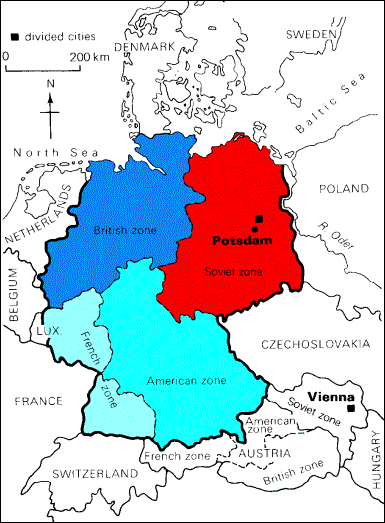
- Germany was divided into four occupation zones controlled by the US, UK, France, and the Soviet Union, with Berlin itself split into four sectors despite sitting deep inside the Soviet zone
Policies for Post-War Germany
The Allies agreed on a set of principles sometimes called the "Five Ds" (though three dominated the discussions):
- Demilitarization: Germany's armed forces were dissolved and its war-making capacity dismantled. Arms factories were destroyed or converted to civilian production.
- Denazification: Nazi Party members were removed from positions of influence in government, courts, schools, and the media. Trials were held, most famously at Nuremberg (beginning November 1945).
- Democratization: New political systems were to be built from the ground up, including free elections, new constitutions, and protections for civil liberties.
- Reparations: The Soviet Union, which had suffered enormous wartime destruction, was to take reparations from its own zone plus a percentage of industrial equipment from the western zones. This arrangement became a major source of friction.
- Industrial restrictions: Germany's heavy industry was capped to prevent rearmament, which slowed economic recovery in the early postwar years.
Territorial and Geopolitical Changes
- Poland's western border was moved to the Oder-Neisse line, transferring large areas of prewar Germany (Silesia, Pomerania, parts of East Prussia) to Polish administration
- This triggered massive population transfers: roughly 12 million ethnic Germans were expelled from Poland, Czechoslovakia, and other parts of Central Europe, one of the largest forced migrations in history
- Disagreements at Potsdam over reparations, governance, and political systems foreshadowed future Cold War conflicts, including the Berlin Blockade of 1948–1949
Germany's Division: Causes
Ideological Differences
The wartime alliance between the Western powers and the Soviet Union was always one of convenience. Once the common enemy was defeated, their incompatible visions for Europe's future became impossible to paper over.
- The Western Allies favored capitalist free-market economies and multiparty democracy; the Soviet Union pushed for socialist planned economies and single-party communist rule
- Each side implemented its own model in its occupation zone. Western zones held democratic elections, while the Soviet zone merged political parties into the communist-dominated Socialist Unity Party (SED) by 1946
- The economic divide deepened sharply after 1947, when the US launched the Marshall Plan, pouring billions of dollars into Western European recovery. The Soviet Union rejected Marshall Plan aid for itself and its satellites, tightening economic control over its zone instead.

Cold War Tensions
- In June 1948, the Western Allies introduced a new currency (the Deutsche Mark) in their zones to stabilize the economy. Stalin saw this as a provocation and responded with the Berlin Blockade, cutting off all road and rail access to West Berlin.
- The Western Allies sustained West Berlin for nearly a year through the Berlin Airlift (June 1948–May 1949), flying in food, fuel, and supplies. The blockade's failure was a major embarrassment for the Soviet Union.
- Military alliances hardened the split: NATO was founded in April 1949 (with West Germany joining in 1955), and the Warsaw Pact followed in 1955
- Germany became the frontline of a global superpower rivalry involving nuclear arms, espionage, and proxy conflicts
Formal Establishment of Two German States
- The Federal Republic of Germany (West Germany, or FRG) was established in May 1949 with its capital in Bonn, governed under a new democratic constitution called the Basic Law
- The German Democratic Republic (East Germany, or GDR) was established in October 1949 with its capital in East Berlin, modeled on the Soviet system
- Each state developed its own constitution, government, legal system, and economic structure: a social market economy in the West versus a centrally planned economy in the East
Allied Influence on Germany
Western Allied Approach
The three Western occupiers did not always agree at first, but they gradually converged on a shared strategy of rebuilding West Germany as a stable, democratic, and economically strong partner.
- The United States took the lead in establishing democratic institutions and free-market economics. The Marshall Plan (1948–1952) provided roughly $1.4 billion to West Germany, fueling industrial recovery.
- The United Kingdom contributed to denazification and helped build democratic governance structures, including an independent judiciary and free press
- France initially took a more punitive approach, seeking to limit German industrial capacity and even detach border regions like the Saar. By the early 1950s, however, France shifted toward cooperation, co-founding the European Coal and Steel Community (1951) with West Germany to bind their economies together.
- Together, the Western Allies supported a federal system that decentralized power across West German states (Länder), deliberately preventing the concentration of authority that had enabled dictatorship
Soviet Approach in East Germany
- The Soviet Union imposed a socialist economic system with state ownership of major industries and central planning
- A one-party political structure was established under the SED, with elections that offered no genuine choice
- Agriculture was collectivized and private businesses were nationalized
- East Germany was integrated into the Comecon (Council for Mutual Economic Assistance), tying its economy to the Soviet bloc
Long-Term Impact of Occupation Policies
The divergent approaches of the occupying powers created two fundamentally different societies on the same national soil.
- West and East Germany developed distinct cultural and social identities shaped by their respective systems
- Educational systems diverged: Western schools emphasized critical thinking and pluralism, while Eastern schools promoted Marxist-Leninist ideology
- Media landscapes split between a free press in the West and state-controlled media in the East
- Even urban planning reflected ideological differences, with East German cities rebuilt along socialist principles (wide boulevards, uniform housing blocks like those on East Berlin's Karl-Marx-Allee)
Consequences of German Division
Immediate Effects
- Two separate German states emerged with incompatible political, economic, and social systems
- Families and communities were separated, creating deep personal hardships and national trauma
- Travel and communication between East and West were severely restricted, with limited phone lines and censored mail
- The Berlin Wall, constructed in August 1961, became the most visible symbol of division, built primarily to stop the flood of East Germans emigrating westward (roughly 3.5 million had left by 1961)
Economic Disparities
- West Germany experienced the Wirtschaftswunder ("economic miracle"), with GDP growing rapidly through the 1950s and 1960s, driven by Marshall Plan investment, currency reform, and export-oriented industry
- East Germany's centrally planned economy produced lower living standards, with chronic shortages of consumer goods and limited product variety
- Infrastructure and technology fell increasingly behind in the East, while the West became one of Europe's wealthiest nations
- By the 1980s, West German GDP per capita was roughly double that of East Germany
International Relations and Alliances
- West Germany joined the European Economic Community (EEC, forerunner of the EU) and NATO, anchoring itself firmly in the Western bloc
- East Germany joined the Warsaw Pact and Comecon, reinforcing the global Cold War divide
- Diplomatic recognition became a battleground: West Germany's Hallstein Doctrine (1955) threatened to cut ties with any country that recognized East Germany, though this policy was eventually abandoned under Willy Brandt's Ostpolitik in the early 1970s
- Germany's division directly influenced European arms control negotiations and nuclear weapons policy throughout the Cold War
Long-Term Consequences
- Reunification in 1990 brought enormous challenges: integrating two economies at vastly different levels of development, restructuring East German industry, and reconciling different legal and educational systems
- The phenomenon of Ostalgie (nostalgia for aspects of East German life) reflected the difficulty of merging two populations with 40 years of separate experiences and memories
- Persistent differences between eastern and western regions remain visible today in unemployment rates, wage levels, voting patterns, and attitudes toward government
- Addressing the legacy of division continues to shape German politics, economics, and social dynamics well into the 21st century
See Fiveable more often in Google
Mark Fiveable as a preferred source and Google is more likely to show you our guides in Top Stories, with a "preferred" badge in AI Mode and AI Overviews.