16.2 Pentose Phosphate Pathway

🧬Biochemistry Unit 16 Review
16.2 Pentose Phosphate Pathway
🧬 Biochemistry
The pentose phosphate pathway is a crucial metabolic process that generates NADPH and ribose-5-phosphate. It works alongside glycolysis to provide essential molecules for cellular functions. This pathway is divided into two phases: oxidative and non-oxidative.
The oxidative phase produces NADPH, vital for biosynthesis and cellular protection. The non-oxidative phase interconverts sugar phosphates, creating ribose-5-phosphate for nucleotide synthesis. This flexibility allows cells to adapt to varying metabolic needs.
Oxidative Phase

Top images from around the web for Glucose Oxidation and NADPH Production
Frontiers | Flux Connections Between Gluconate Pathway, Glycolysis, and Pentose–Phosphate ... View original
Is this image relevant?
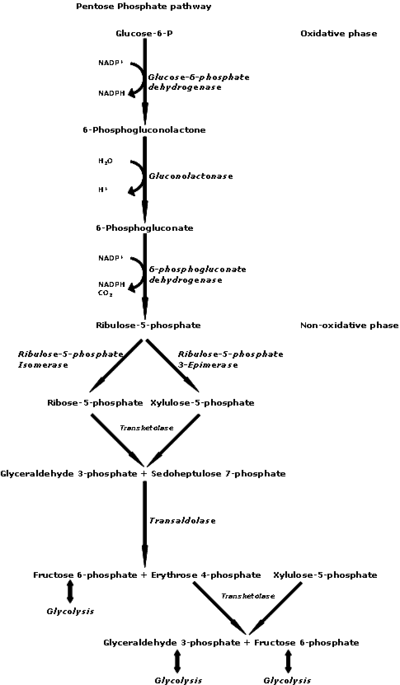
Pentose phosphate pathway - Wikipedia View original
Is this image relevant?
Glucose-6-phosphate dehydrogenase - wikidoc View original
Is this image relevant?
Frontiers | Flux Connections Between Gluconate Pathway, Glycolysis, and Pentose–Phosphate ... View original
Is this image relevant?
Pentose phosphate pathway - Wikipedia View original
Is this image relevant?
Glucose Oxidation and NADPH Production
- Oxidative phase initiates the pentose phosphate pathway by oxidizing glucose-6-phosphate
- Glucose-6-phosphate dehydrogenase catalyzes the first reaction converting glucose-6-phosphate to 6-phosphogluconolactone
- Generates one molecule of NADPH
- Rate-limiting step of the pentose phosphate pathway
- 6-phosphogluconate dehydrogenase catalyzes the second reaction converting 6-phosphogluconate to ribulose-5-phosphate
- Produces a second molecule of NADPH
- Releases CO2 as a byproduct
- NADPH production serves as a crucial reducing agent for biosynthetic reactions (fatty acid synthesis, cholesterol synthesis)
- Maintains glutathione in its reduced form, protecting cells from oxidative stress
- Supports the function of NADPH oxidase in immune cells for pathogen destruction

Regulatory Mechanisms of the Oxidative Phase
- Glucose-6-phosphate dehydrogenase activity regulated by NADPH/NADP+ ratio
- High NADPH levels inhibit the enzyme, slowing down the pathway
- Low NADPH levels activate the enzyme, increasing flux through the pathway
- Hormonal regulation influences enzyme activity
- Insulin stimulates glucose-6-phosphate dehydrogenase activity
- Glucocorticoids suppress enzyme activity
- Genetic variations in glucose-6-phosphate dehydrogenase can lead to deficiency disorders (favism)

Non-Oxidative Phase
Interconversion of Sugar Phosphates
- Non-oxidative phase involves a series of reversible reactions interconverting sugar phosphates
- Transketolase catalyzes the transfer of two-carbon units between sugar phosphates
- Requires thiamine pyrophosphate as a cofactor
- Participates in two separate reactions within the pathway
- Transaldolase facilitates the transfer of a three-carbon unit between sugar phosphates
- Works in conjunction with transketolase to complete the pathway
- Ribose-5-phosphate generated as a key product of the non-oxidative phase
- Essential component for nucleotide synthesis (DNA, RNA)
- Can be converted back to glucose-6-phosphate in times of low NADPH demand
- Erythrose-4-phosphate produced as another important intermediate
- Precursor for aromatic amino acid synthesis (phenylalanine, tyrosine, tryptophan)
- Utilized in the shikimate pathway in plants and microorganisms
Pathway Flexibility and Metabolic Integration
- Non-oxidative phase demonstrates reversibility allowing adaptation to cellular needs
- Can generate ribose-5-phosphate when nucleotide synthesis is prioritized
- Can recycle pentose phosphates back to glycolytic intermediates when NADPH is in excess
- Interconnects with glycolysis and gluconeogenesis through shared intermediates
- Fructose-6-phosphate and glyceraldehyde-3-phosphate serve as connection points
- Pathway flux adjusts based on cellular demands for NADPH, ribose-5-phosphate, and glycolytic intermediates
- Rapidly dividing cells prioritize ribose-5-phosphate production for nucleotide synthesis
- Lipogenic tissues emphasize NADPH production for fatty acid synthesis
See Fiveable more often in Google
Mark Fiveable as a preferred source and Google is more likely to show you our guides in Top Stories, with a "preferred" badge in AI Mode and AI Overviews.