16.3 Fructose and Galactose Metabolism

🧬Biochemistry Unit 16 Review
16.3 Fructose and Galactose Metabolism
🧬 Biochemistry
Fructose and galactose are the two major monosaccharides besides glucose that your body needs to metabolize for energy. They can't enter glycolysis directly the way glucose does, so each one has its own dedicated set of enzymes that converts it into glycolytic intermediates.
These pathways matter clinically because genetic deficiencies in any of the key enzymes cause serious disease. They also matter nutritionally: fructose metabolism, in particular, has unique features that link high fructose intake to metabolic problems like fatty liver and insulin resistance.
Fructose Metabolism

Top images from around the web for Enzymatic Conversion of Fructose
Bacterias Actuaciencia: Aldolasa, la fructosemia y la importancia de ser diploide View original
Is this image relevant?
5.2C: Connecting Other Sugars to Glucose Metabolism - Biology LibreTexts View original
Is this image relevant?
Metabolic Reactions | Boundless Anatomy and Physiology View original
Is this image relevant?
Bacterias Actuaciencia: Aldolasa, la fructosemia y la importancia de ser diploide View original
Is this image relevant?
5.2C: Connecting Other Sugars to Glucose Metabolism - Biology LibreTexts View original
Is this image relevant?
Enzymatic Conversion of Fructose
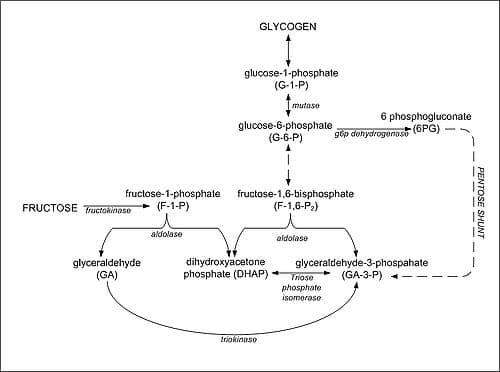
Fructose enters its own pathway rather than the standard hexokinase/glucokinase step that glucose uses. The key organ here is the liver, though the small intestine and kidney also express the necessary enzymes.
Step-by-step breakdown:
-
Fructokinase phosphorylates fructose to fructose-1-phosphate (F1P), consuming one ATP. Note that this produces F1P, not fructose-6-phosphate, so the product cannot be acted on by phosphofructokinase (PFK-1).
-
Aldolase B cleaves F1P into two three-carbon fragments:
- Dihydroxyacetone phosphate (DHAP), which enters glycolysis directly
- Glyceraldehyde, which is not phosphorylated yet
-
Triokinase phosphorylates glyceraldehyde to glyceraldehyde-3-phosphate (G3P), using another ATP. G3P then enters glycolysis.
So the net entry cost is 2 ATP to feed one fructose into glycolysis at the triose level.
When fructose intake is very high, F1P accumulates faster than aldolase B can cleave it. This buildup traps inorganic phosphate () in the form of F1P, which can inhibit glycogenolysis and gluconeogenesis by depleting the free pool the liver needs for those processes.

Metabolic Significance and Disorders
The most important concept here is the PFK-1 bypass. Glucose metabolism is tightly regulated at the PFK-1 step, which acts as a gatekeeper controlling how fast carbon flows through glycolysis. Fructose skips this checkpoint entirely because it enters below PFK-1 as DHAP and G3P. That means:
- Carbon from fructose floods into the lower half of glycolysis without feedback inhibition.
- Excess acetyl-CoA produced this way is channeled into de novo lipogenesis (fatty acid and triglyceride synthesis).
- Chronic high fructose consumption is therefore linked to increased hepatic lipogenesis, elevated blood triglycerides, and development of insulin resistance.
Hereditary fructose intolerance (HFI) results from a deficiency in aldolase B.
- F1P accumulates massively in the liver after fructose ingestion, trapping phosphate and depleting ATP.
- Symptoms include vomiting, severe hypoglycemia (because gluconeogenesis and glycogenolysis are inhibited), and progressive liver damage.
- Diagnosis is through genetic testing or, less commonly, liver biopsy.
- Treatment is strict lifelong avoidance of fructose, sucrose (which contains fructose), and sorbitol (which is converted to fructose). This means avoiding most fruits, table sugar, and many processed foods.
Don't confuse HFI with essential fructosuria, a benign condition caused by fructokinase deficiency. Without fructokinase, fructose simply isn't phosphorylated in the liver; it stays in the blood and spills into the urine. No toxic intermediates accumulate, so there are no symptoms.

Galactose Metabolism
Leloir Pathway: Enzymatic Steps
Galactose is converted to a glucose derivative through the Leloir pathway, named after Nobel laureate Luis Federico Leloir. The pathway uses UDP-sugar intermediates, which makes it distinct from fructose metabolism.
Step-by-step breakdown:
-
Galactokinase phosphorylates galactose to galactose-1-phosphate (Gal-1-P), consuming one ATP.
-
Galactose-1-phosphate uridylyltransferase (GALT) transfers the UMP group from UDP-glucose onto Gal-1-P. This produces two products:
- UDP-galactose
- Glucose-1-phosphate (G1P), which can enter glycolysis (via conversion to G6P by phosphoglucomutase) or be used in glycogen synthesis
-
UDP-galactose 4-epimerase interconverts UDP-galactose back to UDP-glucose, regenerating the UDP-glucose consumed in step 2.
The elegance of this pathway is that UDP-glucose acts as a recycling cofactor. It's consumed in step 2 and regenerated in step 3, so only a catalytic amount is needed to keep the cycle running.
Metabolic Significance and Disorders
Galactose is one half of lactose (galactose + glucose), the primary sugar in milk. Lactase in the small intestine cleaves lactose, releasing free galactose that must then be processed through the Leloir pathway. This pathway is especially critical in infants, whose diet is almost entirely milk-based.
Galactosemia refers to a group of inherited disorders caused by deficiencies in Leloir pathway enzymes:
| Type | Enzyme Deficient | Severity | Key Features |
|---|---|---|---|
| Classic galactosemia | GALT | Severe | Failure to thrive, liver damage, cataracts, intellectual disability if untreated |
| Galactokinase deficiency | Galactokinase | Mild | Cataracts (galactitol accumulates in the lens), but no liver damage |
| Epimerase deficiency | UDP-galactose 4-epimerase | Variable | Rarest form; ranges from benign to severe depending on which tissues are affected |
In classic galactosemia (the most tested form), Gal-1-P accumulates because GALT is absent. This is toxic to the liver, brain, and kidneys. Excess galactose is also shunted into an alternative pathway where aldose reductase converts it to galactitol, a sugar alcohol that accumulates in the lens of the eye and causes cataracts.
- Newborn screening programs detect classic galactosemia early.
- Treatment is immediate and strict removal of galactose and lactose from the diet, which means eliminating dairy products and other lactose-containing foods.
- Even with dietary management, some patients develop long-term complications (speech and motor delays), suggesting that endogenous galactose production also contributes to toxicity.
A useful comparison: in galactokinase deficiency, galactose itself accumulates (leading to galactitol and cataracts), but Gal-1-P does not build up because the kinase step never happens. That's why galactokinase deficiency is much milder than classic galactosemia, where the toxic intermediate Gal-1-P is the main problem.
See Fiveable more often in Google
Mark Fiveable as a preferred source and Google is more likely to show you our guides in Top Stories, with a "preferred" badge in AI Mode and AI Overviews.