7.3 Problem Solving

🥸Intro to Psychology Unit 7 Review
7.3 Problem Solving
🥸 Intro to Psychology
Problem-Solving Strategies and Approaches
Problem-solving is a core cognitive skill that shows up everywhere, from figuring out a math proof to planning your weekend. Psychologists have identified several strategies people use to find solutions, along with common mental traps that get in the way. This section covers the main strategies, the difference between algorithms and heuristics, and the biases that can derail your thinking.
Problem-Solving Strategies in Practice
Trial and error involves testing possible solutions one at a time and learning from mistakes to refine your approach. It works best for well-defined problems with a limited number of options, like solving a combination lock or figuring out which key opens a door.
Means-end analysis compares where you are now (current state) to where you want to be (goal state), then identifies steps to close that gap. You break a big problem into smaller sub-goals. Planning a vacation itinerary is a good example: you figure out the destination, then flights, then hotels, then daily activities, each step reducing the distance between "no plan" and "trip ready."
Working backwards starts at the desired outcome and traces steps back to the starting point. This is especially useful when the goal is clear but the path to get there isn't. Math proofs often work this way: you know what you need to prove, so you reason backward to find the assumptions that get you there.
Analogical problem solving takes a solution from a similar past problem and applies it to a new one. The key is recognizing structural similarities between situations, even when the surface details differ. A classic research example is Duncker's radiation problem, where participants solved it more easily after hearing an analogous story about a general attacking a fortress from multiple directions.
Algorithms vs. Heuristics
These are two broad approaches to solving problems, and they trade off between accuracy and speed.
- Algorithms are step-by-step procedures that guarantee a correct answer if followed precisely. Think of a mathematical formula or a recipe. They're reliable but can be slow and impractical for complex, real-world problems. You wouldn't use an algorithm to decide what to eat for lunch.
- Heuristics are mental shortcuts or "rules of thumb" that give you a quick, good-enough answer. They're useful when a problem is too complex or too vague for an algorithm, but they can lead you astray.
Three heuristics show up frequently in intro psych:
- Representativeness heuristic: You judge how likely something is based on how well it matches a mental prototype. If someone is quiet, wears glasses, and loves books, you might guess they're a librarian rather than a salesperson, even though there are far more salespeople in the world. This can lead to ignoring base rate information (the actual statistical likelihood).
- Availability heuristic: You estimate how common something is based on how easily examples come to mind. People tend to overestimate the risk of plane crashes because dramatic crashes get heavy media coverage, while car accidents (statistically far more dangerous) feel routine.
- Anchoring and adjustment heuristic: You start with an initial piece of information (the "anchor") and adjust from there, but usually not enough. If a store lists a jacket at $200, then marks it down to $120, that $200 anchor makes $120 feel like a deal, even if the jacket is only worth $80.

Obstacles to Effective Problem-Solving
Functional fixedness is the tendency to see objects only in terms of their typical use. In a classic experiment, participants struggled to mount a candle on a wall when tacks were presented inside a box, because they saw the box as just a container, not as a potential shelf. Overcoming functional fixedness means considering unconventional uses for the tools you have.
Mental set is the habit of approaching new problems the same way you've solved past ones, even when a different strategy would work better. The Einstellung effect is a specific version of this: in chess, experienced players sometimes miss a better move because they lock onto a familiar pattern. Consciously questioning your assumptions can help break a mental set.
Confirmation bias is the tendency to seek out information that supports what you already believe while ignoring evidence that contradicts it. If you're convinced a particular study strategy works, you might only notice the times it helped and overlook the times it didn't. This distorts both problem-solving and everyday decision-making.
Overconfidence bias means overestimating the accuracy of your own judgments or abilities. Studies consistently show that people rate their confidence higher than their actual accuracy. This can lead you to underestimate how hard a problem is or skip gathering information you actually need.
Cognitive load refers to the total mental effort being used in working memory. When cognitive load is high (you're juggling too much information at once), your problem-solving ability drops. This is why simplifying a problem or writing things down can make a real difference.
Improving Problem-Solving and Decision-Making
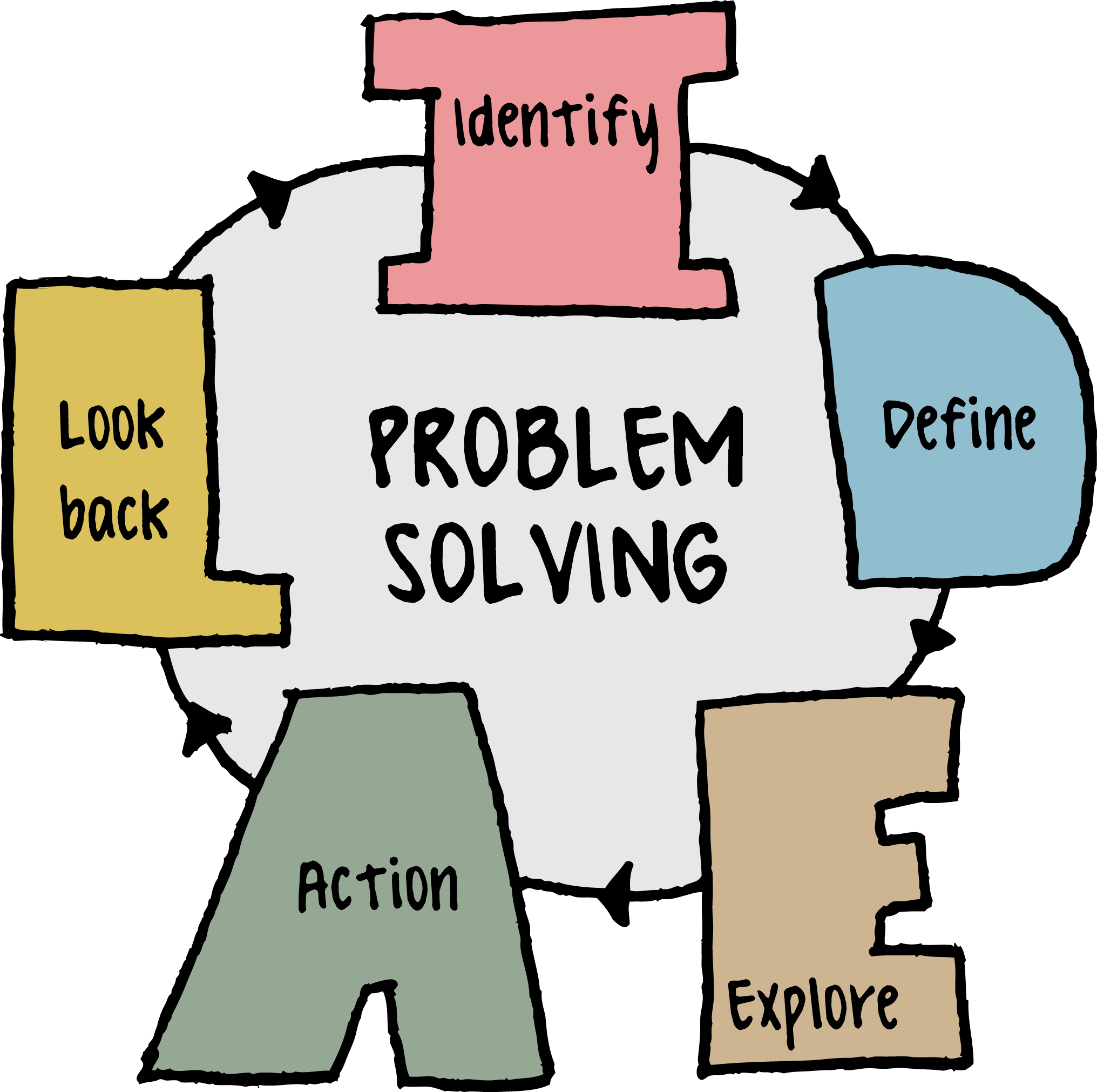
Strategies for Overcoming Obstacles
Divergent thinking means generating multiple, varied solutions rather than zeroing in on one answer right away. Brainstorming (producing as many ideas as possible without judging them) and lateral thinking (approaching a problem from an unexpected angle) are two common techniques that promote this.
Metacognition is thinking about your own thinking. When you pause to ask yourself, "Is my approach actually working?" or "Am I falling into a mental set right now?", you're using metacognition. Self-reflection and adjusting your strategy based on how things are going makes you a more flexible problem-solver.
Growth mindset, a concept from Carol Dweck's research, is the belief that abilities can be developed through effort and practice. People with a growth mindset are more likely to persist through difficulty and learn from mistakes, rather than giving up when a problem feels hard.
Decision-making tools add structure to complex choices:
- Decision matrices let you evaluate options against weighted criteria. For example, choosing a college by scoring each school on cost, location, and program quality, then comparing totals.
- Cost-benefit analysis compares the potential gains and losses of each option to identify the most advantageous path forward.
Creative Problem Solving and Insight
A few more concepts round out this topic:
- Problem space is your mental representation of all the possible states and moves in a problem. The bigger and more complex the problem space, the harder the problem tends to be.
- Insight is that "aha" moment when a solution suddenly clicks after you've been stuck. It feels different from grinding through a problem step by step because the answer seems to appear all at once.
- Incubation is the idea that stepping away from a problem and doing something else can actually help you solve it. Your brain keeps processing the problem unconsciously, which is why solutions sometimes pop into your head in the shower or on a walk.
- Creative problem solving involves generating novel, effective solutions, often by reframing the problem or combining ideas in unexpected ways. It draws on many of the strategies above: divergent thinking, analogical reasoning, and overcoming fixedness.
See Fiveable more often in Google
Mark Fiveable as a preferred source and Google is more likely to show you our guides in Top Stories, with a "preferred" badge in AI Mode and AI Overviews.