7.1 Linnaean Classification System

🧑🏽🔬History of Science Unit 7 Review
7.1 Linnaean Classification System
🧑🏽🔬 History of Science
Carl Linnaeus revolutionized biology in the mid-18th century by creating a systematic way to organize and name every known living thing. Before his work, naturalists across Europe used inconsistent, often lengthy descriptions to identify species, making scientific communication a mess. His classification system introduced two key innovations: a hierarchical structure of categories and binomial nomenclature (a standardized two-part naming system for species).
While Linnaeus assumed species were fixed and unchanging, his framework gave biologists a shared language that persists to this day and set the stage for later breakthroughs in evolutionary thinking.
Linnaean Classification System
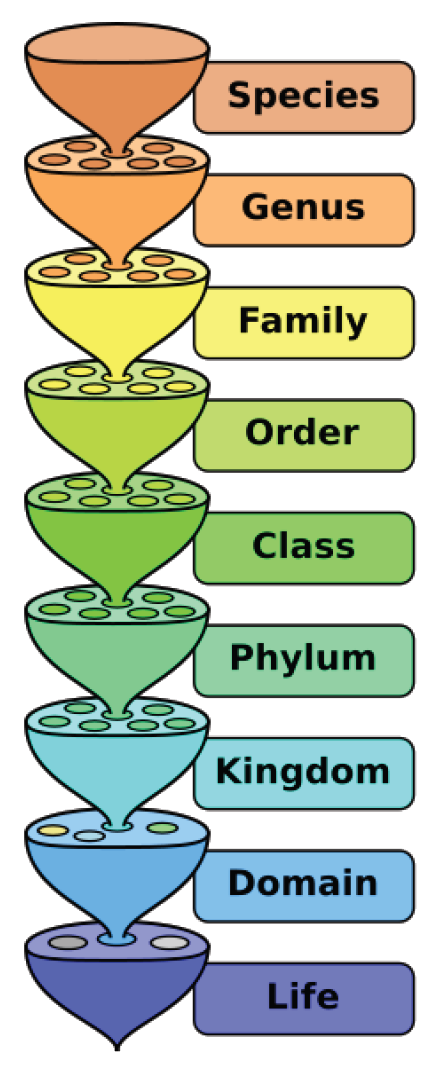
Hierarchical Structure and Categories
The Linnaean system organizes all organisms into a series of nested groups, moving from broad categories down to very specific ones. Each level is based on shared physical characteristics: organisms grouped together at a lower level share more traits than those grouped together at a higher level.
The categories, from most inclusive to most specific:
- Kingdom
- Phylum (called "Class" in Linnaeus's original scheme for plants; "Phylum" was formalized later)
- Class
- Order
- Family
- Genus
- Species
Every species belongs to exactly one genus, every genus to one family, and so on up the chain. This nesting is what makes the system hierarchical.
Linnaeus originally sorted all of nature into three kingdoms:
- Regnum Animale (animals)
- Regnum Vegetabile (plants)
- Regnum Lapideum (minerals)
The mineral kingdom is worth pausing on. Linnaeus saw himself as classifying all of nature, not just living things. He dropped the mineral kingdom from later editions of Systema Naturae as his focus narrowed to organisms. The modern system has expanded well beyond his original kingdoms (adding Fungi, Protista, and eventually the domain system above kingdom), but those changes came long after Linnaeus.
Assumptions and Limitations
Linnaeus worked within the widely held 18th-century belief that species were fixed creations, each designed by God and unchanging over time. This idea of a static natural order shaped his entire approach: classification was about cataloging what existed, not explaining how it got there.
Because he had no concept of evolution or common descent, his system grouped organisms purely by visible similarities. Two species could look alike for very different reasons (convergent evolution, as later biologists would discover), but Linnaeus had no way to distinguish superficial resemblance from genuine relatedness. A classic example: he might group two unrelated organisms together simply because they shared a similar body shape or flower structure.
Binomial Nomenclature's Significance
Two-Part Naming System
Binomial nomenclature gives every species a unique two-part Latin name: the genus name followed by the specific epithet. The genus name is capitalized, the specific epithet is lowercase, and the whole name is italicized: Homo sapiens, Canis lupus.
The genus name does double duty. It identifies the species and simultaneously tells you which broader group (genus) that species belongs to, linking the name directly to the hierarchical classification. So when you see Canis lupus (gray wolf) and Canis familiaris (domestic dog), the shared genus name Canis immediately tells you these species are closely related.
Before Linnaeus, species were often described with long Latin phrases called polynomial names, sometimes five or more words long. A single species of plant might be referred to by a different multi-word phrase by every author who wrote about it. The two-name system was dramatically simpler and more consistent.
Standardization and Universal Language
Common names cause real problems in science. The bird Americans call a "robin" (Turdus migratorius) is a completely different species from the British "robin" (Erithacus rubecula). Binomial nomenclature eliminates this confusion by giving each species one universally recognized name.
Using Latin (and sometimes Latinized Greek) meant the names weren't tied to any living language or nation. A botanist in Japan and a botanist in Brazil could refer to the same organism without ambiguity. In the 18th century, Latin was already the shared scholarly language of Europe, so this choice felt natural and practical.
Impact of Linnaean System
Comprehensive Framework for Classification
Before Linnaeus, there was no widely accepted system for organizing the sheer diversity of life. Linnaeus personally classified around 12,000 species of plants and animals in his major work Systema Naturae (first published in 1735, with expanded editions through 1768). That was an enormous catalog for the time. His framework gave other naturalists a structure they could plug new discoveries into, which became increasingly important as European exploration brought back specimens from around the world.
By organizing species into nested groups based on shared traits, the system also made patterns visible. Naturalists could see clusters of similar organisms and begin asking why certain groups shared so many features. This kind of pattern recognition eventually fed into Darwin's work on common descent a century later.
Lasting Influence on Modern Biology
Linnaeus's hierarchical categories and binomial nomenclature remain the backbone of biological classification today. Modern taxonomy has added new tools (DNA sequence analysis, cladistics) and revised many of Linnaeus's original groupings, but the basic structure of ranked categories and the two-part naming convention are still in use. The International Code of Zoological Nomenclature and the International Code of Nomenclature for algae, fungi, and plants both trace their conventions back to Linnaeus's system.

Linnaean vs. Earlier Systems
Limitations of Earlier Systems
Linnaeus wasn't the first person to try classifying life. Two important predecessors:
- Aristotle (4th century BCE) divided organisms into plants and animals, then subdivided animals by characteristics like habitat, mode of reproduction, or whether they had blood (roughly corresponding to vertebrates and invertebrates). His system was influential for nearly two thousand years but lacked standardized naming and consistent organizing principles across groups.
- John Ray (17th century) grouped organisms by shared physical traits and developed a more rigorous species concept, defining a species partly by its ability to reproduce and produce similar offspring. However, Ray's system still lacked a clear hierarchy of nested categories and a uniform naming convention.
Both approaches were limited in scope and inconsistent in structure, making them hard for other naturalists to adopt or build on.
Advancements of the Linnaean System
Linnaeus improved on earlier efforts in two concrete ways. First, his hierarchical categories gave classification a clear, repeatable structure that anyone could follow. Second, binomial nomenclature replaced the unwieldy polynomial descriptions with clean, standardized names. Together, these innovations made it possible to classify far more species in a way that other scientists could actually use and extend.
Shared Limitations with Earlier Systems
For all its improvements, the Linnaean system shared a fundamental limitation with its predecessors: it grouped organisms by outward physical similarity, not by evolutionary relationships. Linnaeus, Aristotle, and Ray all lacked any understanding of the mechanisms driving biological diversity. Their systems could describe what existed but couldn't explain why certain organisms resembled each other. That explanatory framework wouldn't arrive until Darwin's theory of natural selection, published in On the Origin of Species in 1859.
See Fiveable more often in Google
Mark Fiveable as a preferred source and Google is more likely to show you our guides in Top Stories, with a "preferred" badge in AI Mode and AI Overviews.