11.4 Industry-Specific Formatting Requirements

✍️Screenwriting II Unit 11 Review
11.4 Industry-Specific Formatting Requirements
✍️ Screenwriting II
Script Formats
Spec Scripts and Shooting Scripts
These two formats serve very different purposes, and knowing the difference matters.
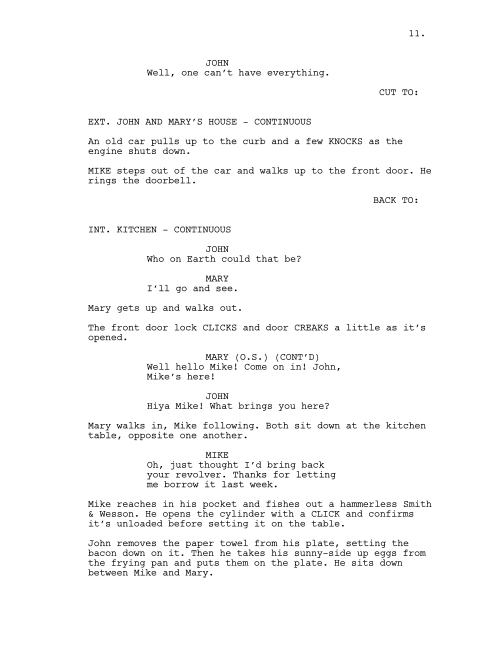
A spec script (short for "speculative") is what you write on your own to sell or get noticed. It's stripped down and focused purely on storytelling. You leave out camera angles, shot descriptions, and technical directions because your job here is to make the reader experience the story, not plan the production. Think of it as a reading document.
A shooting script is what gets used during actual production. It includes scene numbers, camera angles, transitions, and other technical details that the director, DP, and crew need to do their jobs. You don't write a shooting script unless you've been hired to or you're directing your own project.
What they share in common:
- 12-point Courier font (always, no exceptions)
- Margins: 1.5 inches on the left, 1 inch on the right, 1 inch top and bottom
- Page numbers in the upper right corner, starting on page 2
- Standard formatting for scene headings (sluglines), action lines, and dialogue blocks
The left margin is wider to leave room for the binding brads. Small detail, but readers notice if it's wrong.
Television Scripts and Page Count Standards
TV formatting follows most of the same rules as features, but with a few key differences depending on the show type.
- One-hour dramas generally follow feature film formatting conventions. The structure is similar, though you'll see act breaks clearly marked (ACT ONE, ACT TWO, etc.) to indicate where commercial breaks fall.
- Half-hour sitcoms sometimes use a different layout entirely. Multi-camera sitcoms (think studio audience shows) often use a dual-column format with action on one side and dialogue on the other, and dialogue is double-spaced and in all caps. Single-camera comedies typically use standard screenplay format.
- Act breaks and commercial placement indicators appear in network TV scripts. Streaming shows may omit these since there are no commercial interruptions, though act structure still exists.
Page count standards follow the "one page equals roughly one minute of screen time" rule:
- Feature film specs: 90–120 pages (comedies often land closer to 90–100; epics can push toward 120)
- Half-hour TV scripts: 22–35 pages (multi-cam sitcoms tend toward the higher end because of double-spacing)
- One-hour TV scripts: 45–63 pages
Going significantly over or under these ranges signals to readers that something is off with your pacing.

Title Page and Scene Numbering
Title Page Formatting
Your title page is the first thing anyone sees, so it needs to be clean and correctly laid out. There's no room for creativity here.
Centered on the page:
- The script title in all caps (same 12-point Courier as the rest of the script, not a larger font)
- A double-space, then "Written by" (or "by")
- Another double-space, then the writer's name
In the bottom-left corner:
- Your contact information (phone, email), or your agent/manager's contact info if you have representation
In the bottom-right corner (optional):
- Draft date
- WGA registration number or copyright notice
The title page does not get a page number. Keep it simple. No graphics, no fancy fonts, no taglines or quotes.
Scene Numbering and Revision Marks
Scene numbers only appear in shooting scripts, never in spec scripts. Adding scene numbers to a spec is one of the fastest ways to signal that you don't know the conventions.
In a shooting script, scene numbers are placed on both the left and right margins of each scene heading, making them easy to reference during production. They run consecutively (1, 2, 3, etc.) throughout the script.
When scenes are added during revisions, they get letter suffixes to avoid renumbering the entire script. So if a new scene is inserted between scenes 12 and 13, it becomes 12A. A second addition becomes 12B.
Revision tracking follows a specific color-coded system:
- White — first distributed draft
- Blue — first revision
- Pink — second revision
- Yellow — third revision
- Green — fourth revision
- (The sequence continues with goldenrod, buff, salmon, cherry, tan, and then back to white as "double white")
Asterisks (*) in the right margin mark the specific lines that changed in each revision. Revised scene numbers also get an asterisk. Each revision date is noted on the title page so everyone can confirm they're working from the current draft.
Production and Coverage
Production Drafts
A production draft is the working document that the entire cast and crew relies on during filming. It evolves from the shooting script and gets increasingly detailed as departments add their own notes and breakdowns.
Production drafts typically include:
- Watermarks with the draft number and date (to prevent unauthorized distribution)
- Colored revision pages inserted as changes are made
- Scene breakdowns distributed alongside the script
- Script supervisor's notes tracking continuity
Different departments pull specific information from the production draft for their own prep work: props lists, wardrobe notes, special effects requirements, location details, and more. The script becomes a living document that changes throughout the shoot.
Coverage Format
Coverage is a standardized report that readers, assistants, and story analysts write to evaluate scripts for producers and executives. Writers almost never see their own coverage, as it's treated as a confidential internal document.
A standard coverage report follows this structure:
- Header/title page with basic script info: title, writer, genre, draft date, page count, and the name of the reader
- Logline: a one-sentence summary of the story's central conflict
- Synopsis: a 1–2 page plot summary covering all major story beats (including the ending)
- Comments: an analytical section evaluating character development, dialogue quality, story structure, originality, marketability, and sometimes budget considerations
- Ratings grid: numerical or categorical scores (poor/fair/good/excellent) for individual elements like premise, structure, characters, and dialogue
- Final recommendation: one of three verdicts: pass, consider, or recommend
Coverage typically runs 3–5 pages total. The tone is objective and analytical. A "recommend" is rare and means the reader thinks the script is worth serious attention. A "consider" means it has notable strengths but also significant issues. Most scripts receive a "pass."
Understanding coverage format matters even if you never write one yourself, because it tells you exactly what industry gatekeepers are evaluating when they read your work.
See Fiveable more often in Google
Mark Fiveable as a preferred source and Google is more likely to show you our guides in Top Stories, with a "preferred" badge in AI Mode and AI Overviews.