AP exam review verified for 2027

AP Physics 1 Unit 8 Review: Fluids

Review AP Physics 1 Unit 8 to build fluency with pressure, buoyancy, and fluid flow using density, Newton's laws, and conservation principles. This unit carries 10-15% of the exam and connects directly to force and energy reasoning from earlier units.

Use the topic guides, practice questions, and FRQ practice available for this unit to work through every major concept before exam day.

What is AP Physics 1 unit 8?

Unit 8 applies the force and energy tools from Units 2 and 3 to substances that have no fixed shape. Fluids include both liquids and gases, and the unit treats them as ideal: incompressible and without viscosity. That simplification makes the math tractable and the physics clean.

Unit 8 is about how fluids exert pressure, how that pressure creates buoyant forces on submerged objects, and how conservation of mass and energy constrain fluid flow through pipes and openings.

Density and pressure are the entry points

Everything in this unit starts with rho = m/V and P = F_perp/A. Density tells you how much mass is packed into a volume; pressure tells you how much perpendicular force acts per unit area. Both quantities feed directly into buoyancy and flow calculations.

Buoyancy comes from pressure differences

The upward buoyant force on any submerged object equals the weight of the fluid it displaces: Fb = rho*V*g. Whether an object floats or sinks depends on whether its weight exceeds, equals, or falls below that buoyant force, which is a direct application of Newton's second law.

Flow obeys conservation laws

For an ideal fluid in a pipe, mass conservation gives A1v1 = A2v2: a narrower pipe means faster flow. Energy conservation gives Bernoulli's equation, which links pressure, height, and speed at any two points along a streamline. Torricelli's theorem is a special case derived from Bernoulli.

Fluids unify force and energy reasoning

Unit 8 is not a standalone topic. Pressure is a force-per-area argument. Buoyancy is Newton's second law applied to an object in a fluid. The continuity equation is conservation of mass. Bernoulli's equation is conservation of mechanical energy. Every major idea in the unit is a restatement of something you already know, applied to substances without a fixed shape.

AP Physics 1 unit 8 topics

8.1

Internal Structure and Density

Defines fluids as substances with no fixed shape and introduces density (rho = m/V) as the key characterizing property. Covers the distinction between solids, liquids, and gases based on intermolecular interactions, and defines an ideal fluid as incompressible and inviscid.

open guide
8.2

Pressure

Defines pressure as P = F_perp/A (a scalar) and develops the depth-pressure relationship P = P0 + rho*g*h. Distinguishes absolute pressure from gauge pressure and explains why pressure in an incompressible fluid depends on depth, not container shape.

open guide
8.3

Fluids and Newton's Laws

Applies Newton's laws to fluid particles and to objects submerged in fluids. Derives the buoyant force Fb = rho*V*g from pressure differences and states Archimedes' principle. Uses free-body diagrams to determine whether objects float, sink, or remain in equilibrium.

open guide
8.4

Fluids and Conservation Laws

Applies conservation of mass to get the continuity equation A1v1 = A2v2 and conservation of mechanical energy to get Bernoulli's equation. Derives Torricelli's theorem as a special case. Explains the inverse relationship between fluid speed and pressure in a horizontal pipe.

open guide
practice snapshot

Hardest AP Physics 1 unit 8 topics

This snapshot uses Fiveable practice activity to show where students tend to miss questions and which review moves are worth prioritizing first.

62%average MCQ accuracy

Across 5.4k multiple-choice practice attempts for this unit.

5.4kMCQ attempts

Practice activity included in this snapshot.

38%average FRQ score

Across 16 scored free-response attempts for this unit.

Hardest topics in unit 8

MCQ miss rate
8.4

Review Fluids and Conservation Laws with attention to how the concept appears in AP-style source and evidence questions.

40%1,640 tries
8.2

Review Pressure with attention to how the concept appears in AP-style source and evidence questions.

34%1,321 tries

Unit 8 review notes

8.1

Properties of Fluids and Density

A fluid is any substance with no fixed shape, so both liquids and gases qualify. The distinction between solids, liquids, and gases comes from the strength of intermolecular interactions and molecular spacing. An ideal fluid is incompressible (constant density regardless of pressure) and has no viscosity. Density is the foundational quantity for the rest of the unit.

  • Density formula: rho = m/V, measured in kg/m^3. Density is an intensive property: it does not change with the amount of substance.
  • Ideal fluid: Incompressible (volume and density stay constant under pressure) and inviscid (no internal friction). AP Physics 1 treats all fluids as ideal.
  • Solids vs. liquids vs. gases: Solids have strong intermolecular forces and fixed shape; liquids have moderate forces and fixed volume but no fixed shape; gases have weak forces, no fixed shape, and no fixed volume.
If a 0.5 kg object has a volume of 0.0002 m^3, what is its density? (Answer: 2500 kg/m^3.) Would it float or sink in water (rho_water = 1000 kg/m^3)?
PropertySolidLiquidGas
Fixed shapeYesNoNo
Fixed volumeYesYesNo
Intermolecular forcesStrongModerateWeak
Counts as a fluidNoYesYes
8.2

Pressure at a Surface and Pressure with Depth

Pressure is the perpendicular force per unit area on a surface: P = F_perp/A. It is a scalar, so it has no direction. In a fluid, pressure increases with depth because the weight of the fluid above adds to the reference pressure. Absolute pressure at depth h is P = P0 + rho*g*h, where P0 is the surface (reference) pressure. Gauge pressure is the amount above P0, equal to rho*g*h.

  • P = F_perp/A: Pressure equals the perpendicular force component divided by the area over which it acts. Units are Pascals (Pa = N/m^2).
  • Absolute pressure: P = P0 + rho*g*h. Total pressure at depth h, including the reference pressure P0 at the surface.
  • Gauge pressure: P_gauge = rho*g*h. The pressure above the reference pressure; what a pressure gauge reads.
  • Scalar nature of pressure: Pressure has no direction. A fluid exerts pressure equally in all directions at a given depth.
  • Incompressible fluid and pressure: For an ideal fluid, density stays constant regardless of pressure, so rho*g*h applies uniformly at a given depth.
A diver is 10 m below the surface of water (rho = 1000 kg/m^3, P0 = 101,000 Pa, g = 10 m/s^2). What is the absolute pressure at that depth? What is the gauge pressure?
QuantityFormulaWhat it measures
Absolute pressureP = P0 + rho*g*hTotal pressure including surface reference
Gauge pressureP_gauge = rho*g*hPressure above the reference level
Surface pressureP0 (e.g., P_atm)Reference pressure at the fluid surface
8.3

Buoyancy and Newton's Laws in Fluids

Newton's laws apply to fluid particles just as they do to solid objects. The macroscopic behavior of a fluid results from the combined internal particle interactions and external forces such as gravity. The buoyant force is the net upward force a fluid exerts on a submerged object, arising from the pressure difference between the bottom and top of the object. Archimedes' principle states that this force equals the weight of the displaced fluid.

  • Buoyant force formula: Fb = rho_fluid * V_displaced * g. The fluid's density and the volume of fluid displaced determine the upward force, not the object's own density.
  • Archimedes' principle: The buoyant force on any object equals the weight of the fluid it displaces. This follows from the pressure difference between the bottom and top surfaces of the object.
  • Floating condition: An object floats when Fb = weight of the object, meaning rho_object = rho_fluid for full submersion, or the object displaces only enough fluid to match its weight when partially submerged.
  • Sinking condition: An object sinks when its weight exceeds the maximum buoyant force (full submersion), which occurs when rho_object > rho_fluid.
  • Free-body diagram in a fluid: Draw weight (mg downward) and buoyant force (Fb upward). Apply Newton's second law: net force = ma. For equilibrium, Fb = mg.
A wooden block (mass 2 kg, volume 0.004 m^3) is fully submerged in water (rho = 1000 kg/m^3, g = 10 m/s^2). What is the buoyant force? What is the net force on the block, and in which direction will it accelerate?
ScenarioConditionNet force direction
Object floatsrho_object < rho_fluid (partial submersion)Zero (equilibrium)
Object is neutrally buoyantrho_object = rho_fluidZero (equilibrium)
Object sinksrho_object > rho_fluidDownward
8.4

Continuity Equation and Bernoulli's Equation

Two conservation laws govern ideal fluid flow. Conservation of mass gives the continuity equation: A1v1 = A2v2. Where a pipe narrows, the fluid speeds up to keep the flow rate constant. Conservation of mechanical energy gives Bernoulli's equation, which relates pressure, gravitational potential energy per unit volume, and kinetic energy per unit volume at any two points along a streamline. Torricelli's theorem is a direct application of Bernoulli to a fluid exiting an opening.

  • Continuity equation: A1v1 = A2v2. The volume flow rate Q = Av is constant for an incompressible fluid. A smaller cross-section means a higher speed.
  • Volume flow rate: Q = Av, in m^3/s. It equals the volume of fluid passing a cross-section per unit time.
  • Bernoulli's equation: P1 + rho*g*y1 + (1/2)*rho*v1^2 = P2 + rho*g*y2 + (1/2)*rho*v2^2. Expresses conservation of mechanical energy per unit volume along a streamline.
  • Bernoulli's principle (qualitative): Where fluid speed increases, pressure decreases, and vice versa. This follows directly from Bernoulli's equation when height is constant.
  • Torricelli's theorem: v = sqrt(2*g*delta_y). The speed of fluid exiting an opening at the base of a tank equals the speed a free-falling object would reach after falling the same height delta_y. Derived from Bernoulli's equation.
Water flows through a pipe that narrows from area 0.02 m^2 to 0.005 m^2. If the speed in the wide section is 1 m/s, what is the speed in the narrow section? If the pressure in the wide section is 200,000 Pa and both sections are at the same height, what is the pressure in the narrow section? (rho = 1000 kg/m^3)
LawEquationWhat is conserved
Continuity equationA1v1 = A2v2Mass flow rate (volume flow rate for incompressible fluids)
Bernoulli's equationP + rho*g*y + (1/2)*rho*v^2 = constantMechanical energy per unit volume
Torricelli's theoremv = sqrt(2*g*delta_y)Mechanical energy (special case of Bernoulli)

Practice AP Physics 1 unit 8 questions

Try stimulus-based AP practice questions and written prompts after you review the notes.

Example stimulus-based MCQs

open all practice
graph

Stimulus-based practice question

A graph shows the mass mm as a function of volume VV for two different fluids, Fluid 1 and Fluid 2, at a constant temperature. A claim is made that Fluid 1 has a greater density than Fluid 2.

Question

Which of the following best justifies this claim using the provided graph?

The slope of the line for Fluid 1 is greater, and the slope represents the ratio m/Vm/V, which is the density of the fluid.

The area under the line for Fluid 1 is greater, and the area represents the product of mass and volume, which is the density of the fluid.

The line for Fluid 1 reaches a higher maximum mass, indicating that Fluid 1 contains more particles per unit volume.

The slope of the line for Fluid 1 is greater, and the slope represents the ratio V/mV/m, which means the fluid is more compressible.

visual_answers

Stimulus-based practice question

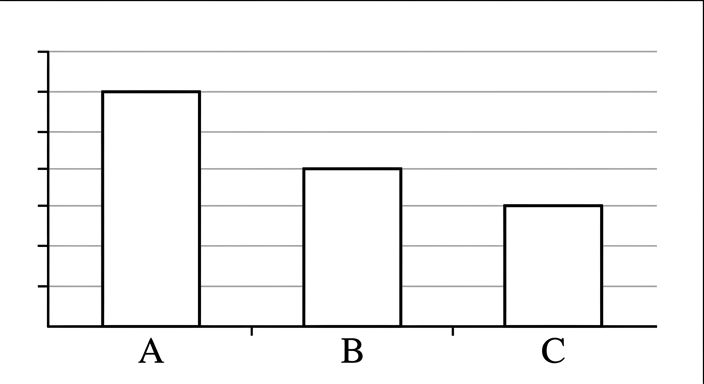
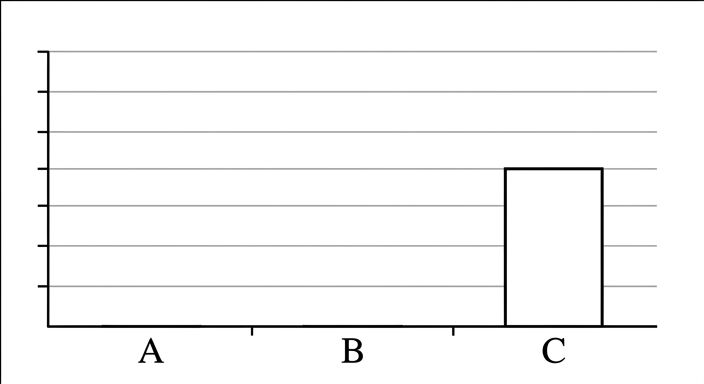
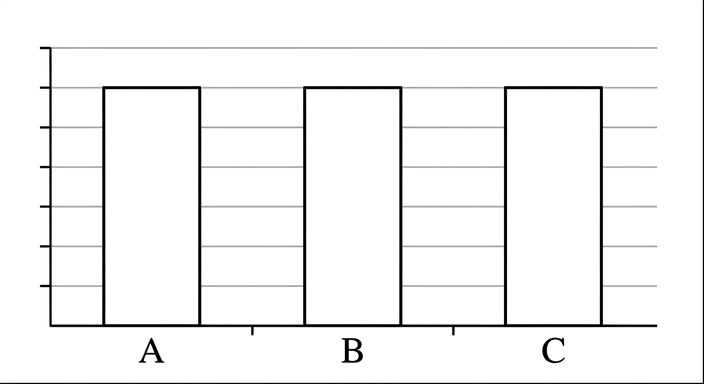
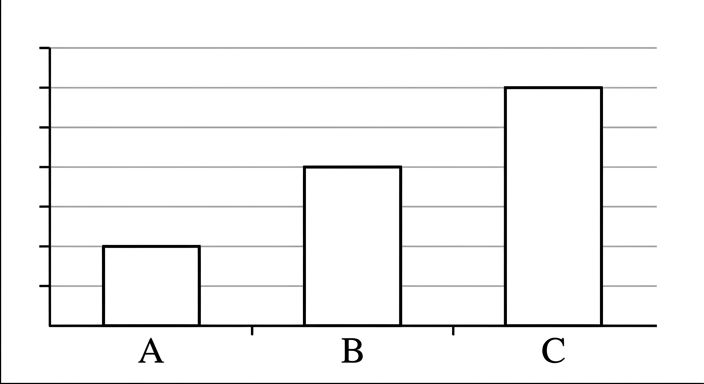
Three solid objects A, B, and C have identical volumes but different masses, such that mA<mB<mCm_A < m_B < m_C. All three objects are held completely submerged in a tank of water. The bar chart shows the mass of each object.

Question

Which of the following bar charts could represent the magnitude of the buoyant force FbF_b exerted on each object while fully submerged?

Answer choice A
Answer choice B
Answer choice C
Answer choice D

Example FRQs

open all FRQs
FRQ

Fluid pressure in narrowing horizontal pipe system

2. Water flows steadily through a horizontal pipe that narrows and then discharges into a vertical transparent cylinder that contains a floating piston, as shown in Figure 1.

Figure 1. Steady flow of water through a horizontal pipe with a constriction, discharging into a vertical cylinder that lifts a frictionless piston.

Figure 1

Figure 2. Pressure bar chart at cross section 1 (students complete bars).

Figure 2

Figure 3. Pressure bar chart at cross section 2 (students complete bars).

Figure 3

Figure 4. Reference pressure bar chart for water just under the piston (given).

Figure 4
A.

Draw shaded bars that represent PatmP_{\text{atm}}, PgP_g, and PtotalP_{\text{total}} to complete the pressure bar charts in Figure 2 and Figure 3 for cross section 1 and cross section 2, respectively. Figure 4 shows a bar chart that represents the atmospheric pressure PatmP_{\text{atm}}, the gauge pressure PgP_g, and the total pressure PtotalP_{\text{total}} of the water just under the piston. Gauge pressure is defined by Pg=PtotalPatmP_g = P_{\text{total}} - P_{\text{atm}}. Atmospheric pressure is the same at all locations. The bars in Figure 4 establish the scale for pressure.

• Shaded bars should start at the dashed line that represents zero pressure.
• Represent any pressure that is equal to zero with a distinct line on the zero line.
• The relative heights of each shaded bar should reflect the magnitude of the respective pressure consistent with the scale used in Figure 4.

Figure 5. Force balance on the piston and hydrostatic pressure relation between cross section 2 and the piston.

Figure 5
B.

Starting with a fundamental physics principle, derive an equation for the total pressure P2P_{2} at cross section 2 in terms of mpm_p, ApA_p, hh, ρ\rho, gg, and PatmP_{\text{atm}}. Your derivation must include (1) an equation representing the force balance on the piston and (2) an equation relating the pressure at cross section 2 to the pressure just under the piston. Begin your derivation by writing a fundamental physics principle or an equation from the reference information. The piston rises slowly, so the piston is in vertical force equilibrium at all times (see Figure 5). The bottom of the piston is h=0.60 mh = 0.60\ \text{m} above cross section 2. The centers of cross sections 1 and 2 are at the same height. The piston has mp=3.0 kgm_p = 3.0\ \text{kg} and Ap=2.0×10³ m2A_p = 2.0× 10^{-3}\ \text{m}^2. Use ρ=1000 kg/m3\rho = 1000\ \text{kg/m}^3, g=9.8 m/s2g = 9.8\ \text{m/s}^2, and Patm=1.01×10⁵ PaP_{\text{atm}} = 1.01× 10^5\ \text{Pa}.

Figure 6. Energy-per-unit-volume terms along the flow from cross section 1 to cross section 2 to just under the piston.

Figure 6
C.

Figure 6 is a graph of energy per unit volume along the flow from cross section 1 to cross section 2 and then upward to just under the piston. The curve labeled 'Dynamic term' represents 12ρv2\tfrac12\rho v^2 and is already drawn. Assume the speed in the vertical cylinder is equal to the speed at cross section 2. The flow is steady, incompressible, and nonviscous.

i.

Sketch and label a curve on Figure 6 that represents the pressure term PP along the flow (from cross section 1 to cross section 2 to just under the piston).

ii.

Sketch and label a curve on Figure 6 that represents the gravitational term ρgh\rho g h along the flow (from cross section 1 to cross section 2 to just under the piston).

D.

Indicate whether the speed v2v_2 of the water at cross section 2 is greater than, less than, or equal to the speed v1v_1 at cross section 1. Use r1=2.0 cmr_1 = 2.0\ \text{cm}, r2=1.0 cmr_2 = 1.0\ \text{cm}, and v1=1.5 m/sv_1 = 1.5\ \text{m/s} at cross section 1. Water is incompressible.

v2>v1v_2 > v_1
v2<v1v_2 < v_1
v2=v1v_2 = v_1
Justify how your response is consistent with the curves you sketched in Figure 6 in part C.

FRQ

Fluid pressure and buoyant force in pipe flow

1. A rigid horizontal pipe carries water that flows steadily from left to right, as shown in Figure 1. The pipe narrows from a wide section to a narrow section. At the wide section the pipe has cross-sectional area A1A_1, and at the narrow section it has cross-sectional area A2A_2. A pressure gauge measures the fluid pressure at each section. A small spherical object is held fully submerged in the water at the wide section by a light string attached to the bottom of the pipe, as shown in Figure 1.

Figure 1. Horizontal rigid pipe with steady incompressible flow from section 1 (wide, area A1) to section 2 (narrow, area A2). Pressures P1 and P2 are measured at the two sections, and a fully submerged sphere in section 1 is tethered by a light string to the bottom of the pipe.

Figure 1

Figure 2. Axes for a student sketch of fluid pressure P versus position x along the pipe from section 1 to section 2.

Figure 2
A.
i.

On the axes shown in Figure 2, sketch a graph of the fluid pressure PP as a function of position xx along the pipe from section 1 to section 2.

ii.

Derive an expression for the speed v2v_2 of the water in the narrow section in terms of v1v_1, A1A_1, and A2A_2. Begin your derivation by writing a fundamental physics principle or an equation from the reference information.

iii.

Derive an expression for the pressure difference P1P2P_1 - P_2 in terms of ρ\rho, v1v_1, A1A_1, and A2A_2. Assume the water is incompressible, the flow is steady, and the pipe is horizontal. Begin your derivation by writing a fundamental physics principle or an equation from the reference information.

B.

Indicate whether the magnitude of the tension in the string is greater than, less than, or equal to the magnitude of the buoyant force on the sphere. The spherical object is held fully submerged and at rest relative to the pipe by the string. The water exerts a buoyant force on the sphere. The water also exerts a pressure force on all points of the sphere's surface, but because the sphere is small compared with the pipe diameter at section 1, the pressure in the surrounding water at the sphere's location may be treated as approximately uniform at a given height.

Greater than
Less than
Equal to
Justify your response by applying Newton's second law to the sphere and identifying the vertical forces acting on it.

FRQ

Fluid pressure changes across varying cross-sectional areas

4. In Scenario 1, water (assumed incompressible) flows steadily through a horizontal pipe segment from left to right, as shown in Figure 1. At location 1 the pipe has cross-sectional area A1=6.0×10⁴ m2A_1 = 6.0\times10^{-4}\ \text{m}^2, and at location 2 the pipe narrows to cross-sectional area A2=3.0×10⁴ m2A_2 = 3.0\times10^{-4}\ \text{m}^2. The volumetric flow rate is constant at Q=1.2×10³ m3/sQ = 1.2\times10^{-3}\ \text{m}^3/\text{s}. The density of water is ρ=1000 kg/m3\rho = 1000\ \text{kg/m}^3. The pressure at location 1 is P1=2.40×10⁵ PaP_1 = 2.40\times10^5\ \text{Pa}. All viscosity effects are negligible.

In Scenario 2, the same horizontal pipe segment carries the same water with the same constant volumetric flow rate Q=1.2×10³ m3/sQ = 1.2\times10^{-3}\ \text{m}^3/\text{s}, but the second location has a larger cross-sectional area A2=9.0×10⁴ m2A_2' = 9.0\times10^{-4}\ \text{m}^2 instead of A2A_2. The cross-sectional area at location 1 remains A1=6.0×10⁴ m2A_1 = 6.0\times10^{-4}\ \text{m}^2, and the pressure at location 1 remains P1=2.40×10⁵ PaP_1 = 2.40\times10^5\ \text{Pa}. All viscosity effects are negligible.

Figure 1. Steady incompressible flow through a horizontal pipe: Scenario 1 (constriction to A2) and Scenario 2 (expansion to A2′).

Figure 1
A.

Refer to Figure 1. Indicate whether the pressure at location 2 in Scenario 1, P2P_2, is greater than, less than, or equal to the pressure at location 2 in Scenario 2, P2P_2', by writing one of the following in your answer booklet.

P2>P2P_2 > P_2'
P2<P2P_2 < P_2'
P2=P2P_2 = P_2'

Justify your answer in terms of how the fluid speed and the energy of the fluid-Earth system change between locations 1 and 2 in each scenario. Use qualitative reasoning beyond referencing equations.

B.

Starting with a fundamental physics principle for fluids and the mass conservation relationship, derive an expression for the pressure difference P1P2P_1 - P_2. Express your answer in terms of ρ\rho, QQ, A1A_1, and A2A_2 only. Begin your derivation by writing a fundamental physics principle or an equation from the reference information. Consider the general case of steady, incompressible, nonviscous flow through a horizontal pipe from location 1 (area A1A_1, pressure P1P_1) to location 2 (area A2A_2, pressure P2P_2) with constant volumetric flow rate QQ and fluid density ρ\rho.

C.

Indicate whether the expression for P1P2P_1 - P_2 you derived in part B is or is not consistent with the claim made in part A. Briefly justify your answer by referencing your derivation in part B and how changing the area at location 2 affects the pressure at location 2.

Key terms

TermDefinition
Archimedes' principleThe buoyant force on an object equals the weight of the fluid it displaces. Mathematically, Fb = rho_fluid * V_displaced * g.
Bernoulli's equationP + rho*g*y + (1/2)*rho*v^2 = constant along a streamline. Expresses conservation of mechanical energy per unit volume in an ideal fluid.
buoyant forceThe net upward force a fluid exerts on a submerged object, resulting from the pressure difference between the bottom and top of the object.
continuity equationA1v1 = A2v2. For an incompressible fluid, the product of cross-sectional area and flow speed is constant, expressing conservation of mass flow rate.
volume flow rateQ = Av, in m^3/s. The volume of fluid passing through a cross-section per unit time. Constant throughout a pipe for an incompressible fluid.
scalarA quantity with magnitude only and no direction. Pressure is a scalar; the force that pressure exerts on a surface is a vector.
macroscopic behaviorThe large-scale, observable behavior of a fluid as a whole, arising from the combined internal particle interactions and external forces such as gravity.

Common unit 8 mistakes

Using the object's density instead of the fluid's density in Fb = rho*V*g

The buoyant force depends on the density of the fluid, not the object. The V in the formula is the volume of fluid displaced, which equals the submerged volume of the object, not necessarily its total volume.

Confusing absolute pressure and gauge pressure

Gauge pressure is rho*g*h alone. Absolute pressure adds the reference pressure P0 (often atmospheric). When a problem asks for total or absolute pressure, include P0. When it asks for gauge pressure, use only rho*g*h.

Forgetting that pressure is a scalar

Pressure has no direction. Do not assign a vector direction to pressure itself. The force that pressure exerts on a surface does have a direction (perpendicular to the surface), but pressure is magnitude only.

Applying the continuity equation to compressible fluids or open systems

A1v1 = A2v2 holds only for incompressible fluids in a closed pipe. It does not apply to gases that can compress or to situations where fluid enters or exits the system at multiple points.

Misidentifying which terms cancel in Bernoulli's equation

Before solving, check whether the two points are at the same height (y1 = y2 cancels the rho*g*y terms) or whether one surface is large enough that its speed is approximately zero (v1 = 0 simplifies the kinetic energy term). Skipping this step leads to algebra errors.

How this unit shows up on the AP exam

Quantitative free-response problems combining multiple fluid concepts

AP Physics 1 free-response questions on fluids often require students to apply two or more concepts in sequence: for example, using density to find whether an object floats, then calculating the buoyant force and applying Newton's second law to find acceleration. Setting up a correct free-body diagram and labeling all forces with correct formulas is essential for earning full credit.

Qualitative and proportional reasoning about pressure and flow

Multiple-choice and free-response items frequently ask students to predict what happens to pressure, speed, or buoyant force when one variable changes, such as when a pipe narrows or an object is pushed deeper. Bernoulli's equation and the continuity equation are the tools for these proportional reasoning tasks. Explaining the physical reasoning behind a prediction, not just stating the answer, is a common scoring requirement.

Derivation and justification tasks using conservation laws

The exam may ask students to derive Torricelli's theorem from Bernoulli's equation or to justify why the continuity equation follows from conservation of mass. These tasks require students to start from a general principle, state assumptions (ideal fluid, incompressible, steady flow), and show algebraic steps. Citing the correct conservation law by name and connecting it to the equation is part of the expected response.

Final unit 8 review checklist

  • Final Unit 8 review checklistUse this list to confirm you can handle every major skill in the fluids unit before the exam.
  • Calculate density and identify fluid typeUse rho = m/V to find density in kg/m^3. Identify whether a substance is a solid, liquid, or gas based on intermolecular forces, and confirm whether it qualifies as an ideal fluid.
  • Apply the pressure equationsCalculate pressure using P = F_perp/A. Find absolute pressure at depth h using P = P0 + rho*g*h and gauge pressure using P_gauge = rho*g*h. Recognize that pressure is a scalar.
  • Analyze buoyancy with free-body diagramsDraw weight and buoyant force on a submerged or floating object. Apply Fb = rho_fluid*V_displaced*g and Newton's second law to determine whether the object floats, sinks, or is in equilibrium.
  • Use the continuity equationApply A1v1 = A2v2 to find the speed of an incompressible fluid in a pipe of changing cross-section. Calculate volume flow rate Q = Av and confirm it is constant throughout the pipe.
  • Apply Bernoulli's equation and Torricelli's theoremSet up P1 + rho*g*y1 + (1/2)*rho*v1^2 = P2 + rho*g*y2 + (1/2)*rho*v2^2 between two points on a streamline. Apply Torricelli's theorem v = sqrt(2*g*delta_y) for fluid exiting an opening in a tank.
  • Connect fluids to earlier unitsRecognize that buoyancy is a Newton's second law problem, that Bernoulli's equation is an energy conservation statement, and that the continuity equation is mass conservation. Draw on Units 2 and 3 reasoning throughout.

How to study unit 8

Start with density and ideal fluid properties (8.1)Read the 8.1 topic guide and practice calculating density using rho = m/V. Make sure you can distinguish solids, liquids, and gases by intermolecular forces and explain what makes a fluid ideal. This foundation is required for every other topic in the unit.
Work through pressure at a surface and with depth (8.2)Practice applying P = F_perp/A and P = P0 + rho*g*h to numerical problems. Drill the difference between absolute and gauge pressure. Use the 8.2 topic guide and attempt several practice questions that vary depth and reference pressure.
Build buoyancy skills with free-body diagrams (8.3)For every buoyancy problem, draw the free-body diagram first: weight down, buoyant force up. Apply Fb = rho_fluid*V_displaced*g and Newton's second law. Practice floating, sinking, and equilibrium scenarios using the 8.3 topic guide and available FRQ practice.
Practice continuity and Bernoulli problems (8.4)Work through pipe-flow problems using A1v1 = A2v2 before adding Bernoulli's equation. Then practice full Bernoulli setups that combine pressure, height, and speed changes. Finish with Torricelli's theorem problems. The 8.4 topic guide and FRQ practice are available for this topic.
Do a full unit review and use the score calculatorAfter covering all four topics, attempt mixed fluids problems that combine density, pressure, buoyancy, and flow in a single scenario. Use the AP score calculator to estimate where your performance puts you on the exam scale and identify which topics need more attention.
More ways to review

Topic study guides

Open the individual guides for Unit 8 when you want a closer review of one topic.

browse guides

FRQ practice

Practice free-response reasoning and compare your answer with scoring guidance.

practice FRQs

Cheatsheets

Use unit cheatsheets for a quick visual review after you work through the notes.

open cheatsheets

Score calculator

Estimate your broader AP score goal after you review the course and exam format.

open calculator

Frequently Asked Questions

What topics are covered in AP Physics 1 Unit 8?

AP Physics 1 Unit 8 covers four topics: **8.1 Internal Structure and Density**, **8.2 Pressure**, **8.3 Fluids and Newton's Laws**, and **8.4 Fluids and Conservation Laws**. Together they build a complete picture of how ideal fluids behave, from why objects sink or float to how energy and momentum are conserved in moving fluids. See everything for this unit at /ap-physics-1-revised/unit-8.

How much of the AP Physics 1 exam is Unit 8?

Unit 8 makes up 10-15% of the AP Physics 1 exam, making it one of the more significant units to know well. It covers fluids topics including density, pressure, buoyancy, and conservation laws applied to fluid systems. That weight means you can expect several multiple-choice questions and a possible FRQ drawing from this material.

What's on the AP Physics 1 Unit 8 progress check (MCQ and FRQ)?

The AP Physics 1 Unit 8 progress check includes both MCQ and FRQ parts drawn from all four unit topics: Internal Structure and Density, Pressure, Fluids and Newton's Laws, and Fluids and Conservation Laws. MCQ questions typically test conceptual understanding of density and pressure relationships, while the FRQ section asks you to apply Newton's laws and conservation principles to fluid scenarios. For matched practice questions, head to /ap-physics-1-revised/unit-8.

How do I practice AP Physics 1 Unit 8 FRQs?

The best way to practice AP Physics 1 Unit 8 FRQs is to focus on the two topics that generate the most free-response material: **8.3 Fluids and Newton's Laws** and **8.4 Fluids and Conservation Laws**. FRQs in this unit often ask you to set up force diagrams for submerged objects, justify buoyancy using pressure differences, or apply continuity and energy conservation to fluid flow. Practice by writing out full justifications, not just equations, since College Board awards points for reasoning. Find Unit 8 FRQ practice at /ap-physics-1-revised/unit-8.

Where can I find AP Physics 1 Unit 8 practice questions?

You can find AP Physics 1 Unit 8 multiple-choice and free-response practice questions at /ap-physics-1-revised/unit-8. That page pulls together MCQ sets and practice test questions covering all four topics: density, pressure, fluids and Newton's laws, and fluids and conservation laws. Working through timed MCQ sets is especially useful since 10-15% of the real exam comes from this unit.

How should I study AP Physics 1 Unit 8?

Start with **8.1 Internal Structure and Density** to lock in the relationship between mass, volume, and density before moving on. From there, build up through pressure (8.2), then connect fluids to Newton's laws (8.3) by drawing force diagrams for objects in fluids. Finish with conservation laws (8.4), where continuity and Bernoulli-style reasoning show up. A few concrete steps that help: - Sketch pressure diagrams for every scenario, not just equations. - Practice explaining buoyancy in words, since FRQs reward written justification. - Do at least one timed MCQ set per topic to catch gaps before the exam. All unit resources are at /ap-physics-1-revised/unit-8.

Ready to review Unit 8?Start with the notes, check the topic cards, and use the practice or resource links when they are available for this course.