4.1 Theravada Buddhism

📿World Religions Unit 4 Review
4.1 Theravada Buddhism
📿 World Religions
continue practicing 4.1
Multiple choice
Theravada Scriptures and Teachings
Theravada Buddhism is the oldest surviving branch of Buddhism, and it centers on one core aim: individual enlightenment. Practitioners follow the teachings preserved in the Pali Canon and work toward Nibbana, the complete liberation from suffering and rebirth. The monks and nuns who have achieved this liberation, called Arhats, serve as spiritual role models for the broader community.
Theravada is sometimes called the "Teaching of the Elders" because it claims the closest connection to the Buddha's original teachings. Its practices revolve around Vipassana meditation, strict monastic discipline, and a close relationship between monks and laypeople. Today, Theravada is the dominant form of Buddhism across much of Southeast Asia.

Top images from around the web for The Pali Canon and Tipitaka
Theravada - Wikipedia View original
Is this image relevant?
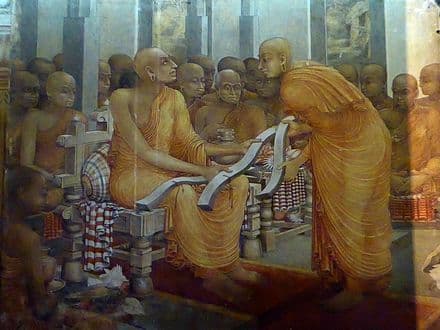
Theravāda Abhidhamma - Wikipedia View original
Is this image relevant?
Theravada (boeddhisme) - Wikipedia View original
Is this image relevant?
Theravada - Wikipedia View original
Is this image relevant?
Theravāda Abhidhamma - Wikipedia View original
Is this image relevant?
The Pali Canon and Tipitaka
The Pali Canon is the standard collection of Theravada scriptures, preserved in the Pali language. It's also called the Tipitaka, which literally means "three baskets," referring to its three major divisions:
- Vinaya Pitaka contains the rules and regulations governing monastic life for monks and nuns. It covers everything from daily conduct to procedures for resolving disputes within the Sangha.
- Sutta Pitaka is the largest section and consists of the Buddha's discourses and dialogues. This is where you'll find teachings on the Four Noble Truths, the Eightfold Path, and many other core doctrines.
- Abhidhamma Pitaka offers detailed, systematic analysis of the Buddha's teachings. It focuses on the nature of mind, matter, and the path to enlightenment, and is considered the most philosophically dense of the three.
The Pali Canon is significant because Theravada Buddhists regard it as the most authentic record of what the Buddha actually taught. Unlike some later Buddhist traditions that added new scriptures, Theravada holds strictly to this collection.

Nibbana and the Arhat Ideal
Nibbana (called Nirvana in Sanskrit) is the ultimate goal in Theravada Buddhism. It refers to the complete liberation from suffering and from samsara, the cycle of death and rebirth.
Achieving Nibbana requires the total eradication of three root causes of suffering:
- Greed (craving and attachment)
- Hatred (aversion and ill will)
- Delusion (ignorance of the true nature of reality)
A person who has fully attained Nibbana is called an Arhat, which literally means "worthy one." Arhats are considered fully liberated and will not be reborn after death.
This is a key distinction between Theravada and Mahayana Buddhism. Theravada emphasizes individual liberation through Arhatship, while Mahayana promotes the Bodhisattva ideal, where practitioners delay their own final liberation to help all beings achieve enlightenment. For Theravada practitioners, becoming an Arhat is the highest spiritual achievement.
_showing_the_events_Wellcome_L0031774.jpg.)
Theravada Practices and Community
Vipassana Meditation
Vipassana means "insight," and this form of meditation is central to Theravada practice. The goal is to develop mindfulness, concentration, and wisdom through direct observation of your own experience.
In practice, Vipassana involves:
- Sitting in a calm, focused posture and directing attention to the breath.
- Gradually expanding awareness to include bodily sensations, thoughts, and emotions.
- Observing all of these with non-judgmental awareness, without clinging to pleasant experiences or pushing away unpleasant ones.
Through sustained practice, meditators gain insight into what Theravada calls the three characteristics of existence:
- Impermanence (anicca): everything is constantly changing.
- Suffering/unsatisfactoriness (dukkha): clinging to impermanent things leads to dissatisfaction.
- Non-self (anatta): there is no permanent, unchanging self or soul.
Recognizing these three marks at a deep, experiential level is what distinguishes Vipassana from simple relaxation. Over time, this insight is understood to weaken attachment and move the practitioner toward Nibbana.
The Sangha and Theravada Countries
The Sangha is the monastic community of monks and nuns who dedicate their lives to studying, practicing, and preserving the Buddha's teachings. They follow the strict code of conduct laid out in the Vinaya Pitaka.
Monks and nuns rely on the lay community for their basic material needs. In return, laypeople earn spiritual merit through dana (generosity), providing monks with the four requisites: food, clothing, shelter, and medicine. This reciprocal relationship is foundational to Theravada society. Monks offer teaching and spiritual guidance; laypeople offer material support.
Theravada Buddhism is the dominant tradition in several Southeast Asian countries:
- Sri Lanka
- Thailand
- Myanmar (Burma)
- Laos
- Cambodia
In these countries, the Sangha is deeply woven into daily life. Monasteries, called viharas, function as centers of meditation, education, and cultural preservation. In Thailand, for example, it's common for young men to spend a period of time as monks, even if they don't remain in the monastic life permanently. The Sangha also plays a role in providing education and social services, making it an integral part of both the religious and civic landscape.
See Fiveable more often in Google
Mark Fiveable as a preferred source and Google is more likely to show you our guides in Top Stories, with a "preferred" badge in AI Mode and AI Overviews.