
Control Volumes and the Reynolds Transport Theorem
Control volumes in fluid mechanics
A control volume is an imaginary region in space that you define as the boundary for analyzing fluid flow. Unlike a system (which tracks a fixed mass of matter as it moves), a control volume stays put while fluid passes through it. This distinction is fundamental: most problems in engineering involve fluid flowing through a device, so tracking a fixed region is far more practical than chasing a blob of fluid downstream.
The boundary of a control volume is called the control surface, and fluid is free to cross it at inlets and outlets. Control volumes can be:
- Fixed in space (e.g., a section of pipe bolted to a wall)
- Moving at constant velocity (e.g., a reference frame attached to a moving vehicle)
- Deforming over time (e.g., the interior of a balloon being inflated)
Typical applications include flow through pipes, HVAC ducts, turbines, and open channels like rivers or canals.

Derivation of Reynolds Transport Theorem
Conservation laws (mass, momentum, energy) are naturally written for a system of fixed mass. But we want to apply them to a control volume where mass flows in and out. The Reynolds Transport Theorem (RTT) is the bridge between these two viewpoints. It tells you how the rate of change of any extensive property for a system relates to what's happening inside a control volume and what's crossing its surface.
Extensive vs. intensive properties. An extensive property depends on the total amount of matter (examples: total mass, total momentum, total energy). Every extensive property has a corresponding intensive property , which is per unit mass. The two are related by:
where is the fluid density and is a differential volume element.
The RTT equation:
Each term has a clear physical meaning:
| Term | Meaning |
|---|---|
| Rate of change of for the system (the physics side, from conservation laws) | |
| Rate of accumulation (or depletion) of stored inside the control volume | |
| Net flux of out through the control surface |
Key details on the flux term:
- is the fluid velocity vector.
- is the outward-pointing unit normal on the control surface.
- The dot product is positive where fluid leaves the CV (outflow) and negative where fluid enters (inflow). This sign convention is what makes the integral give you the net outflow automatically.
- is a differential area element on the control surface.
Applications of Reynolds Transport Theorem
The RTT becomes a specific conservation equation once you choose which extensive property (and its intensive counterpart ) to plug in.
1. Conservation of Mass
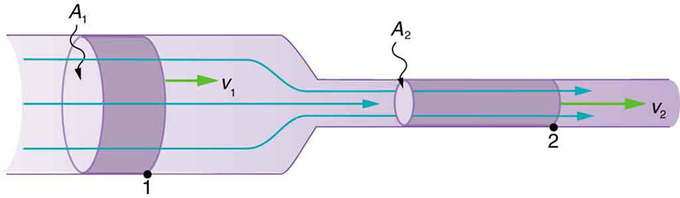
Set (so , the total mass). Since mass is conserved, , giving:
This says that any increase in mass stored inside the CV must be balanced by a net inflow through the surface. For steady flow, nothing changes with time inside the CV, so the storage term vanishes and you get:
which simply means mass in equals mass out.
2. Conservation of Momentum
Set (so , the total momentum). Newton's second law says , giving:
Here includes all external forces on the CV contents: pressure forces at inlets/outlets, gravity (body force), shear stresses on walls, and any reaction forces from supports. This equation is the workhorse for calculating forces on pipe bends, nozzles, and vanes.
3. Conservation of Energy
Set , where:
- = specific internal energy
- = specific kinetic energy
- = specific potential energy (with measured from a reference datum)
The first law of thermodynamics for the system gives:
- is the rate of heat transfer into the CV (positive in).
- is the rate of work done by the CV on its surroundings (positive out). This includes shaft work, pressure work at the boundaries, and shear work.
Pattern to remember: Every application of the RTT follows the same three steps: (1) pick the extensive property and its intensive counterpart, (2) set the left side equal to whatever the relevant conservation law says (zero for mass, net force for momentum, net heat/work for energy), and (3) evaluate the storage and flux integrals for your specific control volume geometry and flow conditions.