
🧬AP Biology Review
How do you use Hardy-Weinberg?
🧬AP Biology
Review
How do you use Hardy-Weinberg?
What is the Hardy-Weinberg Principle? 🤔
The Hardy-Weinberg principle describes the characteristics of a population that is stable over time. In other words, the allele frequencies do not change from generation to generation. In order for a population to be stable and in Hardy-Weinberg Equilibrium, five conditions must be met:
- The population must be very large.
- The population must be isolated from other populations.
- There must be no mutations in the population.
- Mating must be random.
- No natural selection.
Why do we use Hardy-Weinberg? 🤷♀️ 🤷♂️
The Hardy-Weinberg equation is important because it enables us to calculate the frequencies of alleles in a population. Scientists use the letter p to stand for the dominant allele and the letter q to stand for the recessive allele. The equation for Hardy-Weinberg is:
- p^2 + 2pq + q^2 = 1
- p + q = 1
The basis of this equation is a monohybrid cross (Tt x Tt):
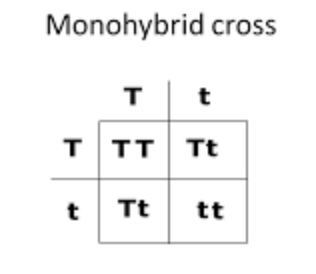
- p^2 = TT (homozygous dominant)
- 2pq = Tt (heterozygous)
- q^2 = tt (homozygous recessive)
Need a review on Punnet Square? Make sure to check out this 🎥 video on Mendelian and Non-Mendelian Genetics for help!
How do we use the Hardy-Weinberg equation? 🖊 📚
The Hardy-Weinberg equation is fairly easy to use if you are given the right information. To demonstrate how to use the equation, we will go through a sample problem.
Example Problem
If 9% of the population has blue eyes, what percent of the population is hybrid for brown eyes? Homozygous for blue eyes?
- The first step in these problems should always be to identify what information is given and what you need to find. In this problem, we are given the percent of the population with blue eyes (q^2). We need to find the percent of the population that is hybrid for brown eyes (2pq) and homozygous for blue eyes (p^2).
- Now that we have our starting point, let's fill in the remaining variables we don't know. Because q^2 = 0.09, we know that q = √0.09 = 0.3 . From there we can find p because p + q = 1. So p = 0.7 and p^2 = 0.49. Lastly, 2pq = 2(0.3)(0.7) = 0.42.
- Now all we have to do is convert our answers to percentages. The percent of the population that is hybrid for brown eyes is 42% because 2pq = 0.42. The percent of the population that is homozygous for blue eyes is 49% because p^2 = 0.49. As you can see, using and understanding Hardy-Weinberg doesn't have to be confusing. If you are ever confused, consider talking to your teacher or chatting with us here at Fiveable. By following the simple steps provided, you'll be a Hardy-Weinberg expert in no time!
Wanting more information -- Check out this 🎥 Hardy-Weinberg video replay and this one covering 🎥 Hardy-Weinberg and Microevolution!