
🎒ACT Review
What's on the ACT?
What's on the ACT?
What is the ACT? How does it work?
The ACT is split into 4 multiple-choice sections (English, Math, Reading, and Science) and an optional essay section. Each multiple-choice section is scored out of 36, and your composite score is the average of your four section scores. That average gets rounded to the nearest whole number. The essay is scored separately and does not affect your composite score.

ACT Test Overview
The ACT tests a wide range of skills across four sections, all under tight time constraints. Compared to the SAT, the ACT tends to be faster-paced with more straightforward questions, while the SAT gives you more time per question and often leans toward abstract or complex problem-solving. Your best bet for deciding between the two is to take a full-length practice test of each under real timing conditions and compare your results.
Breakdown & Scoring
| Section | # of Questions | Time Allotment |
|---|---|---|
| English | 75 MC | 45 min |
| Mathematics | 60 MC | 60 min |
| Reading | 40 MC | 35 min |
| Science | 40 MC | 35 min |
| Essay (optional) | 1 essay | 40 min |
ACT English
In the ACT English section, you'll encounter 5 passages with underlined portions. Your job is to decide whether each underlined portion is correct as written or whether one of the answer choices is a better replacement. Some questions also ask you to reorganize sentences or paragraphs, and others ask about the passage's main idea or purpose. Those bigger-picture questions tend to appear at the end of each passage's question set.
This section tests your grammar and punctuation knowledge alongside your editing and organization skills. Because the English section relies heavily on a set of recurring grammar rules, it's one of the easiest sections to improve on with targeted practice. Learn the rules, drill them, and you'll see results.
English Example Question
The passage will be on the left side and questions on the right. Underlined portions correspond to the question numbers.

Image Courtesy of ACT.org
More English Section Resources
For a solid starting point, check out Fiveable's ACT English Section Overview: What's On It? to understand the different question types you'll face.
ACT Mathematics
You're allowed to use a calculator on the ACT Math section, which helps given the tight pacing (60 questions in 60 minutes). The topics covered include pre-algebra, elementary algebra, intermediate algebra, coordinate geometry, plane geometry, and trigonometry. Most of this material you'll have seen in school by the end of 11th grade.
Don't underestimate the simpler questions. Careless mistakes on straightforward problems are one of the biggest score killers on this section. Brush up on foundational topics and work through plenty of practice problems under timed conditions.
Math Example Question

More Math Section Resources
A great place to start is Fiveable's ACT Math Section Overview: What's On It?:
ACT Reading
After your mid-test break, you'll move into the ACT Reading section. You'll read 4 passages, each paired with 10 multiple-choice questions. The passages always come from four categories: prose fiction (or literary narrative), social science, humanities, and natural science.
Some questions ask about specific details stated in the passage, while others ask you to identify the main idea or make inferences from the text. You can refer back to the passages at any time, so use that to your advantage. Unless a question specifically asks you to infer, the answer will be directly supported by the text.
Reading Example Question

More Reading Section Resources
Start with Fiveable's ACT Reading Section Overview: What's On It?:
Science
The ACT Science section can look intimidating at first because of all the diagrams, tables, and unfamiliar terminology. The good news: this section is more about data interpretation and reasoning than memorized science facts. Most of the information you need is right there in the passages. Only about 3-4 questions across the entire section require outside science knowledge (typically basic biology, chemistry, or physics concepts).
You'll work through 6-7 passages that include both text and visual data. These passages fall into three types:
- Data Representation: Reading and interpreting graphs, tables, and charts
- Research Summaries: Understanding the design and results of scientific experiments
- Conflicting Viewpoints: Comparing different scientific perspectives on the same topic
Example Question

For a thorough overview, check out Fiveable's ACT Science Section Overview: What's On It.
For practice with experimental reasoning questions, see this resource.
ACT Essay

The ACT essay is optional, but some colleges require or recommend it, so check your target schools' requirements before deciding to skip it.
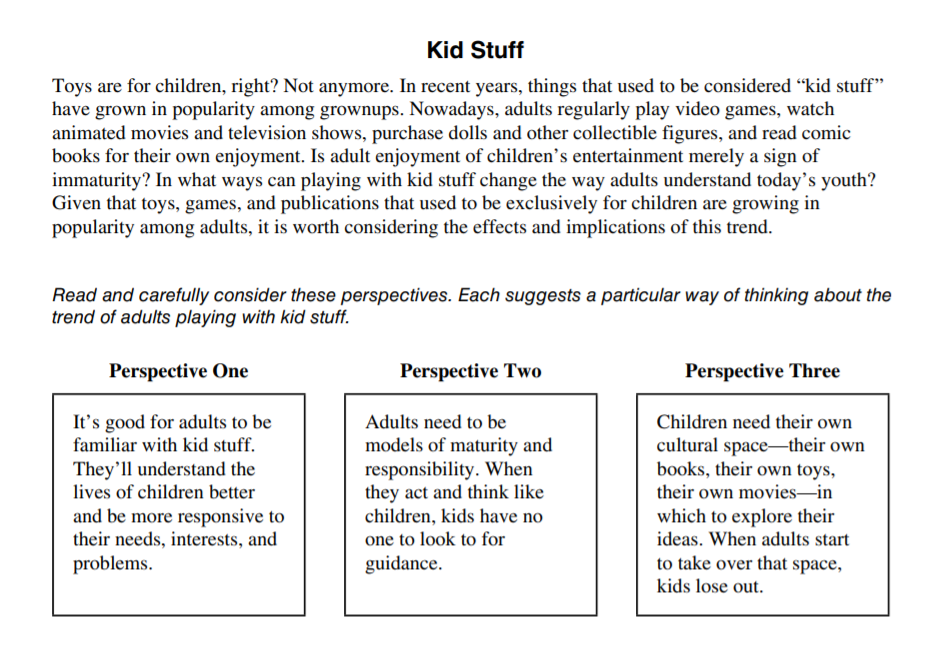
You'll receive a prompt about a societal issue along with a short background description and 3 perspectives on the topic. Your task is to develop your own position. You can fully agree with one of the given perspectives, partially agree, or present an entirely different viewpoint. The key is to analyze the relationship between your perspective and at least one of the others.
You have 40 minutes, so managing your time is critical. Spending about 5 minutes planning, 30 minutes writing, and 5 minutes reviewing is a solid approach.
Example Question
Resources for the ACT Essay
Familiarize yourself with the scoring rubric so you know exactly what graders are looking for. A great starting point: Fiveable's ACT Writing Section Overview: What's On It?
Closing
You should now have a clear picture of what each ACT section looks like, how it's scored, and what kind of content to expect. The biggest challenge for most students is pacing. With 215 multiple-choice questions across 175 minutes, you don't have much time to linger on any single problem. Taking full-length practice tests under realistic timing conditions is the single best way to build the speed and stamina you'll need on test day.
Check out Fiveable's ACT guides and the best ACT prep resources for your next steps.