
The Poisson distribution models rare events occurring in fixed intervals. It's used to calculate probabilities for things like customer arrivals or product defects. The formula uses the average event rate and desired number of occurrences to determine likelihood.
Poisson experiments have key characteristics like independent events and constant average rates. The distribution can also estimate binomial probabilities when there are many trials with low success rates. This simplifies calculations for large-scale scenarios with rare occurrences.
Poisson Distribution
Poisson distribution probability calculations
- Expresses probability of a given number of events occurring within a fixed interval of time or space (minutes, hours, days, area)
- Poisson probability mass function calculates the probability:
- average number of events per interval (expected value)
- mathematical constant (2.71828)
- number of events (non-negative integer)
- factorial of
- Calculate probability of a specific number of events occurring within an interval:
- Identify average number of events per interval ()
- Determine desired number of events ()
- Plug values into Poisson probability mass function
- Examples:
- Probability of 3 customers arriving in a 10-minute interval with an average of 2 customers per 10 minutes
- Probability of 5 defects occurring in a batch of 1000 items with an average defect rate of 0.4%

Key characteristics of Poisson experiments
- Events occur independently of each other (one event does not affect the probability of another)
- Average rate of occurrence remains constant over the interval (consistent average number of events per unit of time or space)
- Two events cannot occur at exactly the same instant (events are discrete)
- Appropriate when:
- Number of possible occurrences is large (many potential events)
- Probability of an event occurring is small (rare events)
- Events are independent of each other (no influence between events)
- Mean and variance of a Poisson distribution equal (expected value)
- Examples:
- Number of phone calls received by a call center per hour
- Number of accidents at a busy intersection per day
- Follows the law of rare events, which states that the total number of events will follow a Poisson distribution if there are many opportunities for an event to occur, but the probability of occurrence for each opportunity is small
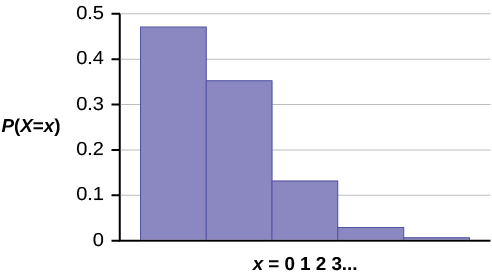
Poisson as binomial distribution estimator
- Approximates binomial distribution under certain conditions:
- Number of trials () is large (many repetitions)
- Probability of success () is small (rare successes)
- Product of and is a constant () (consistent average number of successes)
- When conditions met, Poisson distribution estimates binomial distribution:
- , number of trials, probability of success
- Poisson probability mass function approximates binomial probability mass function
- Advantages of Poisson approximation:
- Simplifies calculations for large and small (easier computation)
- Requires only one parameter () instead of two ( and ) (less information needed)
- Examples:
- Approximating the probability of 2 defective items in a large batch of 5000 with a 0.1% defect rate
- Estimating the probability of 4 successful sales calls out of 200 with a 1.5% success rate
Poisson Processes and Related Concepts
- Homogeneous Poisson process: A process where events occur continuously and independently at a constant average rate
- Non-homogeneous Poisson process: A process where the rate of occurrence varies over time or space
- Intensity function: Describes the rate of occurrence in a non-homogeneous Poisson process
- Cumulative distribution function (CDF): Gives the probability that the number of events is less than or equal to a specific value