
Adjunctions in category theory provide a powerful framework for understanding universal properties. They connect different categories through pairs of functors, revealing deep relationships between mathematical structures.
Universal properties can be expressed using adjunctions, showcasing "best" or "most efficient" ways to perform tasks. This connection helps us construct and analyze important mathematical objects, from free groups to products and limits.
Adjunctions and Universal Properties
Connection of adjunctions to universal properties
- Adjunctions provide a framework for understanding and describing universal properties in category theory
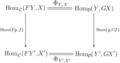
- An adjunction consists of two functors, and , along with a natural bijection between hom-sets:
- The functors and are called adjoint functors, with being the left adjoint and being the right adjoint
- Universal properties can be expressed using the language of adjunctions
- A universal property states that a certain object is "the best" or "the most efficient" way to perform a given task (free groups, products)
- In the context of adjunctions, a universal property corresponds to the existence of a universal morphism, which is a component of the natural bijection between hom-sets (unit and counit)

Equivalence of adjunctions and universal morphisms
- To prove the equivalence, we need to show that the existence of an adjunction implies the existence of universal morphisms and vice versa
- Given an adjunction between categories and , we can construct universal morphisms:
- For each object in , the unit of the adjunction is a universal morphism from to
- For each object in , the counit of the adjunction is a universal morphism from to
- Conversely, given a family of universal morphisms, we can construct an adjunction:
- Define the functor by mapping each object to the codomain of its corresponding universal morphism
- Define the functor by mapping each object to the domain of its corresponding universal morphism
- The natural bijection between hom-sets can be constructed using the universal properties of the given morphisms
Examples of adjunction-derived universal properties
- Free-forgetful adjunctions
- The free functor maps each set to the free group generated by that set
- The forgetful functor maps each group to its underlying set
- The universal property: for any set and any group , morphisms from to in correspond bijectively to group homomorphisms from to in (free groups are "most efficient" way to map sets into groups)
- Product-Hom adjunction
- For any two objects and in a category , there is an adjunction between the product functor and the hom-functor
- The universal property: for any objects , , and in , there is a natural bijection between morphisms in and morphisms in (products are "most efficient" way to pair morphisms)
Applications of adjunctions for universal properties
- Constructing adjoint functors
- To find a left adjoint to a given functor , look for a universal morphism from each object in to (unit of adjunction)
- To find a right adjoint to a given functor , look for a universal morphism from to each object in (counit of adjunction)
- Proving the existence of limits or colimits
- Limits and colimits can be characterized by universal properties (terminal objects, initial objects)
- If a category has a terminal object (limit of empty diagram), then the constant functor mapping each object to the terminal object is a right adjoint to the diagonal functor for any small category
- Dually, if a category has an initial object (colimit of empty diagram), then the constant functor mapping each object to the initial object is a left adjoint to the diagonal functor for any small category