
Natural transformations bridge functors, preserving category structure. They're defined by morphisms between objects, satisfying a naturality condition shown in commutative diagrams. This concept connects functors, allowing us to compare and relate them.
Examples include identity transformations, power set functors, and linear algebra applications. Components of natural transformations involve specifying source and target functors, along with component morphisms for each object in the source category.
Natural Transformations
Definition of natural transformations
- Natural transformation transforms one functor into another while respecting the structure of the categories involved
- Given two functors , a natural transformation from to is a family of morphisms in
- For each object in , there is a morphism
- Morphisms must satisfy the naturality condition: for every morphism in , the following diagram commutes:
</>Code
F(X) --F(f)--> F(Y) | | ηX ηY | | v v G(X) --G(f)--> G(Y)

Commutative diagrams for natural transformations
- Commutative diagram ensures that the natural transformation respects the structure of the categories and functors involved
- Diagram states that applying the natural transformation after the functor is the same as applying the functor and then the natural transformation
- In other words, for every morphism in
- Commutativity of this diagram is necessary and sufficient for a family of morphisms to be a natural transformation
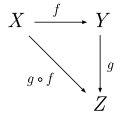
Examples in various categories
- Identity natural transformation
- For any functor , there is an identity natural transformation from to itself
- Component morphisms are the identity morphisms in : for each object in
- Natural transformations between power set functors
- Consider the power set functor and the functor (power set of the power set)
- Natural transformation from to given by component morphisms for each set and each subset
- Natural transformations in linear algebra
- Consider the categories of vector spaces over a field and
- Forgetful functor sends each vector space to its underlying set and each linear map to its underlying function
- Functor sends each set to the vector space (functions from to ) and each function to the linear map given by precomposition with
- Natural transformation from to the identity functor on , given by component morphisms defined by for each vector space and each function
Components of natural transformations
- To define a natural transformation, one needs to specify:
- Source functor
- Target functor
- For each object in , a morphism in , called the component morphism at
- Collection of all component morphisms defines the natural transformation
- Morphisms must satisfy the naturality condition (commutative diagram) for the transformation to be natural
- When specifying a natural transformation, it is crucial to identify the source and target functors, define the component morphisms, and verify that they satisfy the naturality condition