---
title: "Regulation of the Cell Cycle: AP Bio Review"
description: "AP Biology cell cycle regulation review: how checkpoints, cyclins, Cdks, and p53 control division, plus how failures lead to cancer or apoptosis."
canonical: "https://fiveable.me/ap-bio/unit-4/regulation-of-cycle/study-guide/SUgdyIDMLxL6m6S0mS3G"
type: "study-guide"
subject: "AP Biology"
unit: "Unit 4 – Cell Communication and Cell Cycle"
lastUpdated: "2026-06-12"
---
# Regulation of the Cell Cycle: AP Bio Review
## Summary
AP Biology cell cycle regulation review: how checkpoints, cyclins, Cdks, and p53 control division, plus how failures lead to cancer or apoptosis.
## Guide
## Overview
Regulation of the cell cycle is the system of internal checkpoints and proteins that decides when a cell grows, copies its DNA, divides, pauses, or dies. In [AP Bio](/ap-bio "fv-autolink") (Topic 4.6), you need to know how checkpoints, cyclin-dependent kinase (Cdk) and cyclin complexes, and the protein p53 keep division under control, and what happens when that control breaks down: [cancer](/ap-bio/key-terms/cancer "fv-autolink") or apoptosis.
This is part of [Unit 4](/ap-bio/unit-4 "fv-autolink"): Cell Communication and Cell Cycle, which is 10-15% of the AP exam. A common exam mistake is failing to explain the purpose and timing of [cell cycle](/ap-bio/unit-4/homeostasis-feedback-loops/study-guide/OgMSpwCrEez0qyWtlCAC "fv-autolink") checkpoints, so that connection is what this review hammers on. The good news: you don't need to memorize specific cyclin-Cdk pairs or growth factor names. Those are outside the scope of the AP exam. You need the logic of how regulation works.
## Cell Cycle Checkpoints
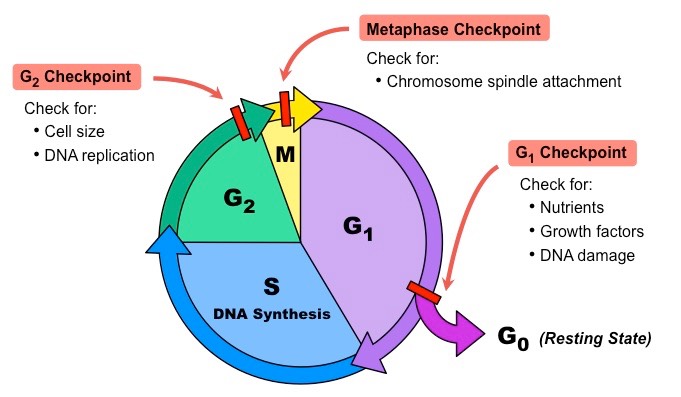
Checkpoints are control points where the cell cycle stops until the cell confirms conditions are correct to continue. Think of them as quality-control inspections. If something is wrong (the cell is too small, the DNA is damaged, the [chromosomes](/ap-bio/unit-5/meiosis/study-guide/FC0aTuODYikjJuhlBO1Z "fv-autolink") aren't lined up), the cycle pauses so the problem gets fixed before it gets copied into the next generation of cells.
There are three main checkpoints:
- **G1 checkpoint (end of G1).** This checks whether the cell is big enough and has enough nutrients and proteins to handle [DNA replication](/ap-bio/unit-6/replication/study-guide/dWnyvQBkJXbdCZAXGCfQ "fv-autolink"). If the cell isn't ready, it can exit into **G0**, a resting phase where it stops dividing but can reenter the cycle later when conditions improve.
- **G2 checkpoint (end of G2, before [mitosis](/ap-bio/key-terms/mitosis "fv-autolink")).** This verifies that DNA was copied correctly and completely during [S phase](/ap-bio/key-terms/s-phase "fv-autolink"). If replication is good, the cell moves into mitosis (M phase).
- **M checkpoint (during [metaphase](/ap-bio/key-terms/metaphase "fv-autolink")).** This confirms that all chromosomes are properly attached to spindle fibers and lined up at the equator before the cell lets [sister chromatids](/ap-bio/key-terms/sister-chromatids "fv-autolink") separate in anaphase.
The big-picture reason checkpoints exist: mistakes in DNA replication create [mutations](/ap-bio/unit-6/mutations/study-guide/WIuGA11Yy2RsVq8JpSnt "fv-autolink"), and accumulated mutations can turn a cell cancerous. Checkpoints catch problems before they spread.
###### Image courtesy of BioNinja.
## Cyclins and Cyclin-Dependent Kinases (Cdks)
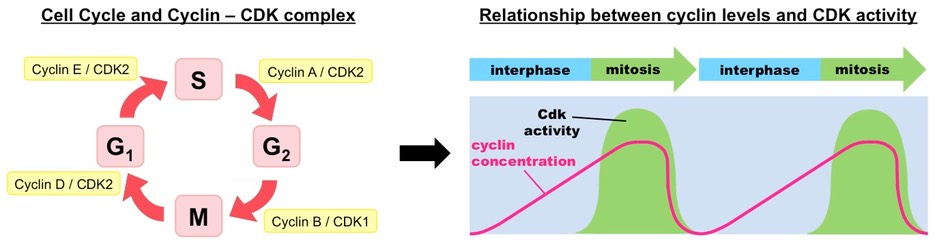
The cell cycle is driven by interactions between cyclins and [cyclin-dependent kinases](/ap-bio/key-terms/cyclin-dependent-kinases "fv-autolink") (Cdks). Cdks are [enzymes](/ap-bio/unit-3/enzyme-structure/study-guide/jsjBfuk2jmYAZVrmVwtF "fv-autolink") that are always present in the cytoplasm, but they only become active when they bind to a cyclin. That's the whole trick: the Cdk is the "engine," and cyclin is the "key" that switches it on.
Here's how the cycle uses this:
- Cyclin levels rise during [interphase](/ap-bio/key-terms/interphase "fv-autolink") as the cell prepares to divide.
- Once cyclin builds up past a certain threshold, it binds Cdk to form an active Cdk-cyclin complex.
- The active complex phosphorylates target proteins, pushing the cell past a checkpoint and into the next phase (for example, triggering mitosis).
- After the phase is done, cyclin is degraded (broken down), the Cdk goes back to its inactive form, and the cycle can start over.
Because cyclin is made and destroyed in waves, the cell gets a built-in timer. Cyclin concentration is the dial the cell uses to control when division happens. You don't need to name specific cyclin-Cdk pairs for the AP exam, just the logic that rising cyclin activates Cdk, which advances the cycle.
###### Image Courtesy of BioNinja
## p53 and the Genes That Regulate Division
Genes and the proteins they code for also regulate the cell cycle, and the most famous example is **p53**, a tumor suppressor protein. When DNA gets damaged by [heat](/ap-bio/unit-3/photosynthesis/study-guide/qIyyKCxB3XJI9oRI7yjl "fv-autolink"), radiation, or chemicals, p53 detects it and halts the cell cycle. Then one of three things happens:
1. p53 triggers DNA repair enzymes to fix the damage.
2. If repair works, the cell cycle resumes and division continues.
3. If the damage is too severe to fix, p53 triggers **apoptosis** ([programmed cell death](/ap-bio/key-terms/programmed-cell-death "fv-autolink")), so the broken cell is eliminated instead of copied.
This is why p53 is such a big deal in cancer research. If p53 malfunctions, damaged DNA goes undetected, the cell doesn't pause, and it keeps dividing with errors. As those errors pile up, the cell can become cancerous.
Several categories of regulatory genes work together, and trouble shows up when they get stuck in the wrong on/off state. These genes don't cause cancer just by existing. The problem is improper regulation:
- **Growth-promoter genes stuck ON** lead to unlimited growth signals.
- **Tumor suppressor genes (like p53) stuck OFF** mean checkpoint "stop" signs get ignored.
- **Apoptosis genes stuck OFF** mean damaged cells never self-destruct.
- **Chromosome-maintenance genes (telomerase) stuck ON** allow unlimited divisions.
- **Touch-sensor genes stuck OFF** let cells overcome density-dependent inhibition and pile up.
## Disruptions: Cancer and Apoptosis
When cell cycle regulation fails, the two main outcomes are cancer or apoptosis. These are the consequences the AP exam expects you to connect back to checkpoints.
**Cancer** happens when cells lose normal regulation and divide uncontrollably. Cancer cells ignore checkpoint signals and the normal limits on division. They can also **metastasize**, meaning they migrate and spread to regions of the body where they didn't originate. Cancer is essentially a failure of the brakes: checkpoints, p53, and apoptosis aren't doing their jobs.
**Apoptosis** is programmed, controlled cell death, and it's a normal, healthy process in multicellular organisms. It keeps cell numbers in balance and removes cells that are damaged, mutated, or no longer needed. For example, apoptosis sculpts tissues during development and clears out cells with DNA damage before they can become dangerous. When your skin peels after a sunburn, you're watching apoptosis remove damaged cells. The flip side: if a damaged or mutated cell never receives the signal to undergo apoptosis, it can keep dividing and contribute to cancer.
So apoptosis and cancer are two sides of the same regulatory coin. Working apoptosis protects the organism; broken apoptosis lets bad cells survive.
## Key Concepts and Vocabulary
- **Cell cycle**: The regulated sequence of interphase (G1, S, G2), mitosis, and cytokinesis that controls cell growth and reproduction in eukaryotes.
- **Checkpoint**: A control point that halts the cell cycle until conditions are confirmed correct to continue.
- **G1 checkpoint**: Checks [cell size](/ap-bio/unit-2/cell-structure-function/study-guide/znjrRPCY6596o2nWt05n "fv-autolink"), nutrients, and proteins before entering S phase.
- **G2 checkpoint**: Checks that DNA was replicated correctly before mitosis.
- **M (metaphase) checkpoint**: Confirms chromosomes are properly attached and aligned before sister chromatids separate.
- **G0 phase**: A resting state where a cell stops dividing but can reenter the cycle in response to appropriate cues.
- **Cyclin-dependent kinase (Cdk)**: An [enzyme](/ap-bio/unit-3/enzyme-catalysis/study-guide/Jg1jljQ8ZHUvcaKprPGy "fv-autolink"), always present in the cytoplasm, that is only active when bound to a cyclin.
- **Cyclin**: A regulatory protein whose levels rise and fall to control Cdk activity and time the cell cycle.
- **Cdk-cyclin complex**: The active enzyme complex that phosphorylates targets to push the cell past checkpoints.
- **p53**: A tumor suppressor protein that detects DNA damage and triggers repair, a cycle pause, or apoptosis.
- **Tumor suppressor gene**: A gene that normally restrains division; its loss removes checkpoint "stop" signals.
- **Apoptosis**: Programmed, controlled cell death that removes damaged or unneeded cells.
- **Cancer**: Uncontrolled cell division resulting from failed cell cycle regulation.
- **Metastasis**: The spread of cancer cells to body regions where they did not originate.
## Common Mistakes
- **Skipping the purpose and timing of checkpoints.** This is the most commonly flagged exam error. Don't just name the G1, G2, and M checkpoints; say what each one checks (size and nutrients, DNA replication, chromosome alignment) and why pausing there prevents errors.
- **Saying cyclin activates the cell cycle by itself.** Cyclin doesn't do the work alone. It binds Cdk to form an active complex, and that complex drives the cycle forward. Cdk is always there; cyclin is the variable that switches it on.
- **Claiming regulatory genes "cause" cancer.** These genes are normal and necessary. Cancer comes from improper regulation (genes stuck on or off), not from the genes existing.
- **Treating apoptosis as accidental or harmful.** Apoptosis is programmed and protective. It removes damaged cells before they spread. The danger is when apoptosis fails, not when it happens.
- **Confusing checkpoint failure with random division.** Cancer isn't cells dividing for no reason. It's cells ignoring checkpoint, p53, and apoptosis signals that should have stopped them.
- **Memorizing specific cyclin-Cdk pairs or growth factors.** That detail is outside the scope of the AP exam. Spend your [energy](/ap-bio/unit-3/environmental-impacts-on-enzyme-function/study-guide/Q8PevM3BI76060aoWtit "fv-autolink") on the regulatory logic instead.
## Practice and Next Steps
To get comfortable with cell cycle regulation, practice explaining cause and effect: if p53 malfunctions, what happens to a cell, and why? If the G2 checkpoint is disabled, what error could slip through? The AP exam often asks you to predict the effect of a disruption to the cell cycle, so train yourself to trace consequences step by step.
Build fluency with these resources:
- Run through [AP Bio guided practice](/ap-bio/guided-practice) for multiple-choice questions on the cell cycle and its regulation.
- Write out a free response and get instant [feedback](/ap-bio/unit-4/changes-signal-transduction-pathways/study-guide/8VXe6lI7DgHLuYDLIpe4 "fv-autolink") with [FRQ practice](/ap-bio/frq-practice), or browse the [FRQ question bank](/ap-bio/frqs).
- Review the full [Unit 4: Cell Communication and Cell Cycle](/ap-bio/unit-4) overview to connect regulation back to signal transduction and feedback.
- Lock in definitions with the [AP Bio key terms glossary](/ap-bio/key-terms) and grab a quick [cheatsheet](/ap-bio/cheatsheets) before a quiz.
- When you're ready to test everything together, try a [full-length practice exam](/ap-bio/practice-exam) and estimate your score with the [AP score calculator](/ap-bio/ap-score-calculator).
## Vocabulary
- **cancer**: A disease resulting from uncontrolled cell division due to disruptions in cell cycle regulation, allowing cells to divide abnormally and form tumors.
- **cell cycle**: A highly regulated series of events that controls the growth and reproduction of eukaryotic cells.
- **cell cycle disruptions**: Abnormal interruptions or malfunctions in the regulated progression of cell division stages, which can lead to cellular dysfunction or disease.
- **checkpoints**: Internal control points in the cell cycle that regulate progression and ensure cells meet specific conditions before advancing to the next phase.
- **cyclin-dependent kinases**: Enzymes that are activated by cyclins and phosphorylate target proteins to regulate progression through the cell cycle.
- **cyclins**: Regulatory proteins that fluctuate in concentration during the cell cycle and control the timing of cell cycle events.
- **internal controls**: Regulatory mechanisms within a cell that monitor conditions and control cell cycle progression.
- **programmed cell death**: Programmed cell death, a controlled process in which a cell actively participates in its own destruction.
## FAQs
### What regulates the cell cycle in AP Bio?
The cell cycle is regulated by internal checkpoints (at the end of G1, the end of G2, and during metaphase) and by proteins, especially cyclin-dependent kinases (Cdks) that activate when bound to cyclins. The tumor suppressor protein p53 also halts the cycle to allow DNA repair or trigger apoptosis. You can review the full picture in [Unit 4](/ap-bio/unit-4).
### What is the difference between cyclins and Cdks?
Cyclin-dependent kinases (Cdks) are enzymes that stay present in the cytoplasm but are inactive on their own. Cyclins are regulatory proteins whose levels rise and fall, and when cyclin levels reach a threshold, cyclin binds Cdk to form an active complex that pushes the cell past a checkpoint. In short, Cdk is the engine and cyclin is the key that turns it on.
### How does the cell cycle relate to cancer?
Cancer results when cell cycle regulation fails and cells divide uncontrollably. If checkpoints, p53, or apoptosis signals don't work, damaged cells keep dividing, accumulate mutations, and can metastasize to other parts of the body. The regulatory genes involved don't cause cancer by existing; the problem is improper on/off regulation.
### What does p53 do in the cell cycle?
p53 is a tumor suppressor protein that detects DNA damage and halts the cell cycle. It triggers DNA repair enzymes, and if the damage is fixed the cycle resumes, but if the damage is too severe it triggers apoptosis (programmed cell death). When p53 malfunctions, damaged cells keep dividing and can become cancerous.
### Why are cell cycle checkpoints a common AP exam mistake?
A frequent AP Biology error is naming the checkpoints without explaining their purpose and timing. To earn points, state what each one checks: the G1 checkpoint checks cell size and nutrients, the G2 checkpoint checks correct DNA replication, and the M (metaphase) checkpoint checks chromosome alignment. Practice predicting what goes wrong if a specific checkpoint fails using [FRQ practice](/ap-bio/frq-practice).
### Do I need to memorize specific cyclin-Cdk pairs for the AP Bio exam?
No. Knowledge of specific cyclin-Cdk pairs or specific growth factors is outside the scope of the AP Biology exam. Focus instead on the regulatory logic: rising cyclin activates Cdk, the active complex advances the cycle, and p53 can halt it for repair or trigger apoptosis.
## Structured Data
```json
{"@context":"https://schema.org","@type":"FAQPage","inLanguage":"en","mainEntity":[{"@type":"Question","@id":"https://fiveable.me/ap-bio/unit-4/regulation-of-cycle/study-guide/SUgdyIDMLxL6m6S0mS3G#what-regulates-the-cell-cycle-in-ap-bio","name":"What regulates the cell cycle in AP Bio?","acceptedAnswer":{"@type":"Answer","text":"The cell cycle is regulated by internal checkpoints (at the end of G1, the end of G2, and during metaphase) and by proteins, especially cyclin-dependent kinases (Cdks) that activate when bound to cyclins. The tumor suppressor protein p53 also halts the cycle to allow DNA repair or trigger apoptosis. You can review the full picture in Unit 4."}},{"@type":"Question","@id":"https://fiveable.me/ap-bio/unit-4/regulation-of-cycle/study-guide/SUgdyIDMLxL6m6S0mS3G#what-is-the-difference-between-cyclins-and-cdks","name":"What is the difference between cyclins and Cdks?","acceptedAnswer":{"@type":"Answer","text":"Cyclin-dependent kinases (Cdks) are enzymes that stay present in the cytoplasm but are inactive on their own. Cyclins are regulatory proteins whose levels rise and fall, and when cyclin levels reach a threshold, cyclin binds Cdk to form an active complex that pushes the cell past a checkpoint. In short, Cdk is the engine and cyclin is the key that turns it on."}},{"@type":"Question","@id":"https://fiveable.me/ap-bio/unit-4/regulation-of-cycle/study-guide/SUgdyIDMLxL6m6S0mS3G#how-does-the-cell-cycle-relate-to-cancer","name":"How does the cell cycle relate to cancer?","acceptedAnswer":{"@type":"Answer","text":"Cancer results when cell cycle regulation fails and cells divide uncontrollably. If checkpoints, p53, or apoptosis signals don't work, damaged cells keep dividing, accumulate mutations, and can metastasize to other parts of the body. The regulatory genes involved don't cause cancer by existing; the problem is improper on/off regulation."}},{"@type":"Question","@id":"https://fiveable.me/ap-bio/unit-4/regulation-of-cycle/study-guide/SUgdyIDMLxL6m6S0mS3G#what-does-p53-do-in-the-cell-cycle","name":"What does p53 do in the cell cycle?","acceptedAnswer":{"@type":"Answer","text":"p53 is a tumor suppressor protein that detects DNA damage and halts the cell cycle. It triggers DNA repair enzymes, and if the damage is fixed the cycle resumes, but if the damage is too severe it triggers apoptosis (programmed cell death). When p53 malfunctions, damaged cells keep dividing and can become cancerous."}},{"@type":"Question","@id":"https://fiveable.me/ap-bio/unit-4/regulation-of-cycle/study-guide/SUgdyIDMLxL6m6S0mS3G#why-are-cell-cycle-checkpoints-a-common-ap-exam-mistake","name":"Why are cell cycle checkpoints a common AP exam mistake?","acceptedAnswer":{"@type":"Answer","text":"A frequent AP Biology error is naming the checkpoints without explaining their purpose and timing. To earn points, state what each one checks: the G1 checkpoint checks cell size and nutrients, the G2 checkpoint checks correct DNA replication, and the M (metaphase) checkpoint checks chromosome alignment. Practice predicting what goes wrong if a specific checkpoint fails using FRQ practice."}},{"@type":"Question","@id":"https://fiveable.me/ap-bio/unit-4/regulation-of-cycle/study-guide/SUgdyIDMLxL6m6S0mS3G#do-i-need-to-memorize-specific-cyclin-cdk-pairs-for-the-ap-bio-exam","name":"Do I need to memorize specific cyclin-Cdk pairs for the AP Bio exam?","acceptedAnswer":{"@type":"Answer","text":"No. Knowledge of specific cyclin-Cdk pairs or specific growth factors is outside the scope of the AP Biology exam. Focus instead on the regulatory logic: rising cyclin activates Cdk, the active complex advances the cycle, and p53 can halt it for repair or trigger apoptosis."}}]}
```